

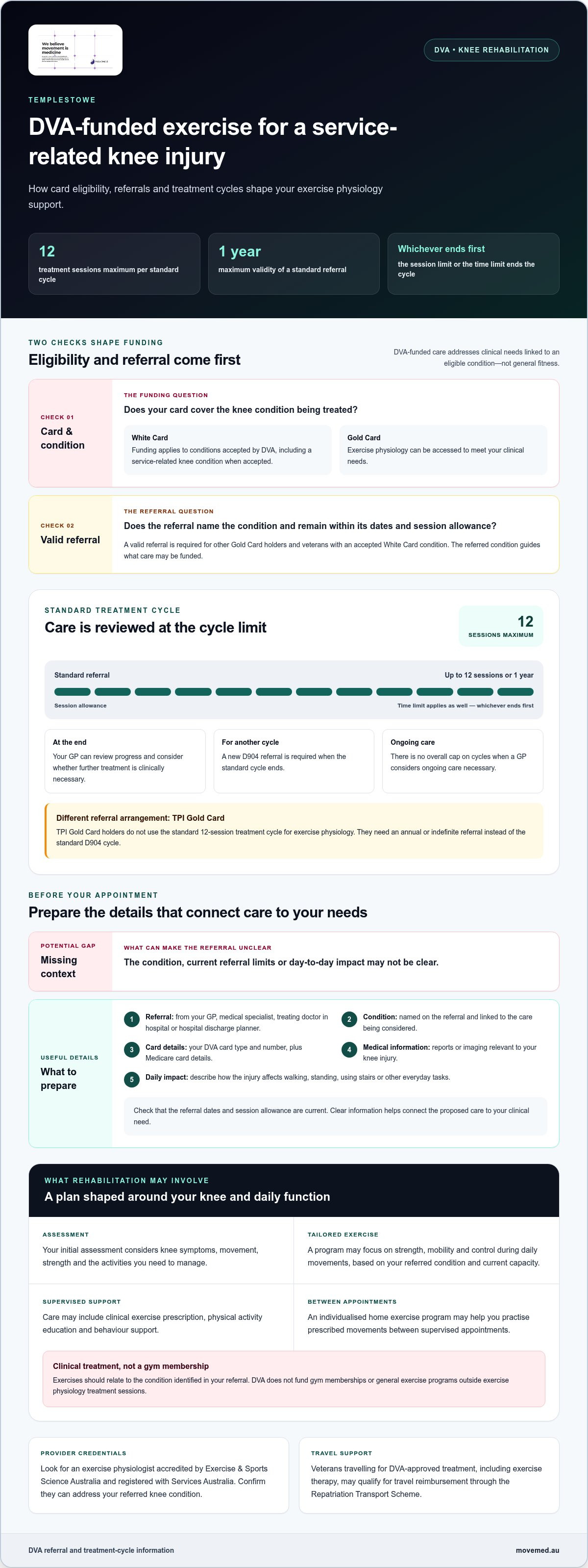
DVA-funded exercise for service-related knee injuries in Templestowe can provide structured rehabilitation when you have a valid referral and the knee condition meets your card’s coverage rules. A standard DVA exercise physiology referral covers up to 12 treatment sessions or one year, whichever ends first. White Card funding applies to conditions accepted by DVA, while Gold Card holders can access care to meet their clinical needs.
DVA-funded exercise for service-related knee injuries in Templestowe can help you work on strength, mobility and confidence through a program tailored to your needs. If knee pain makes walking, standing or everyday tasks difficult, exercise physiology may provide structured, clinically guided support.
This guide explains how exercise physiology may support a service-related knee injury, what referral and medical information to prepare, and how supervised, clinic-based rehabilitation can fit into your recovery. You’ll also learn what to expect from the assessment and how progress can be shaped around your goals and daily activities.
Key Takeaways
- An initial assessment helps shape an exercise program around your knee, movement and everyday goals.
- Prepare your referral, DVA card details and relevant medical information so the referral process is clearer.
- Your card type and whether DVA accepts the knee condition affect what exercise physiology support may be funded.
- Supervised clinic-based rehabilitation can help you practise exercises safely and build confidence as your capacity changes.
How can exercise physiology help veterans?
For a service-related knee injury, exercise physiology uses assessment to guide movement and functional goals. DVA-funded care addresses clinical needs; it is not a general fitness program or gym membership.
Initial assessments and tailored programs
An initial assessment considers your knee symptoms, movement, strength and the activities you need to manage. Explain how the injury affects tasks such as walking, standing or using stairs. The exercise physiologist can use this information to tailor a program to your referred condition and current capacity. Ask how progress will be reviewed and exercises adjusted as your movement changes.
DVA-funded exercise programs
DVA-funded exercise physiology may include clinical exercise prescription, physical activity education and behaviour support. For a knee injury, a program may focus on strength, mobility and control during daily movements. Exercises should relate to the condition identified in your referral, not general fitness goals. DVA does not fund gym memberships or general exercise programs outside exercise physiology treatment sessions.
A standard treatment cycle covers up to 12 sessions or one year, whichever ends first. At the end of the initial 12 sessions, a GP can consider whether further treatment is clinically necessary. A new referral is required for each new cycle. Treatment cycles give the referring GP a point to review your progress and decide whether another period of care is appropriate.
Your plan may include an individualised home exercise program, giving you a way to practise movements between supervised appointments. Exercises can relate to daily routines, such as standing from a chair. Follow the prescribed technique and tell your practitioner at your next review about changes in pain or function.
When choosing a DVA provider for knee rehabilitation, look for an exercise physiologist accredited by Exercise & Sports Science Australia and registered with Services Australia. For Templestowe, DVA-funded care is provided through approved exercise physiology or physiotherapy services; confirm that the practitioner can address your referred knee condition.
DVA-funded rehabilitation for an accepted service-related knee injury can include assessment, supervised exercise and a home program. Veterans travelling for DVA-approved treatment, including exercise therapy, may qualify for travel reimbursement through the Repatriation Transport Scheme.
Referral and medical information requirements
For DVA-funded exercise physiology, begin with a referral from your GP, medical specialist, treating doctor in hospital or hospital discharge planner. The referral should identify the condition being treated. If your knee injury is covered by a White Card, DVA funding is limited to conditions accepted as service-related. Gold Card holders can access exercise physiology to meet their clinical needs.
A standard referral is valid for up to 12 treatment sessions or one year, whichever ends first. Once that treatment cycle ends, a new D904 referral is required for another cycle. Your GP can review your progress and consider whether further treatment is clinically necessary. There is no overall cap on cycles when a GP considers ongoing care necessary, so the renewal decision relates to your needs and progress.
TPI Gold Card holders follow a different referral arrangement. They do not use the standard 12-session treatment cycle for exercise physiology and need an annual or indefinite referral instead of the standard D904 cycle. If you hold a TPI Gold Card, make sure the referral reflects this arrangement. For other Gold Card holders and veterans with an accepted White Card condition, a valid referral is still required.
Gather your paperwork and relevant health details before your appointment. This may include your DVA card type and number, Medicare card details, and medical reports or imaging relevant to your knee. Explain to the referring practitioner how the injury affects daily activities, such as walking or using stairs, so the referral describes your clinical need. A clear referral connects the proposed care to the accepted or eligible condition.
Before booking, check that the referral names the condition for treatment and that its dates and session allowance remain current. Keep a copy of reports or imaging that explain your knee injury, and bring your card details to the appointment. These practical steps can help you prepare for DVA exercise physiology care and discuss your goals with the treating practitioner.
Exercise support for injuries and chronic conditions
A knee injury can affect more than the joint itself. In Australia, exercise physiology can support veterans with a chronic disease or those recovering after hospital treatment for a major injury or illness, when they have an assessed clinical need and an eligible Veteran Card. The exercise plan should address the condition and the movement challenges it creates.
Your card type affects what DVA may cover. Gold Card holders can access exercise physiology to meet their clinical needs. White Card funding applies to conditions accepted by DVA, including a service-related knee condition when accepted. If you have several health concerns, the referred condition and card eligibility guide what support can be funded.
For chronic conditions, exercise physiology can combine clinical exercise prescription, physical activity education and behaviour support. If you manage knee pain alongside another chronic condition, your plan may need to account for both your symptoms and everyday demands. The focus is practical function, such as walking, standing or managing household tasks, rather than exercise participation alone.
Strength and mobility exercises can be selected to match the referred condition. For example, a program may practise controlled knee movement and strengthening related to rising from a chair or walking on level ground. Exercise intensity and movement choices should reflect your assessment and be adjusted as your function changes. Progress is not measured only by repetitions; completing a daily task with greater control can matter too.
DVA-funded group exercise must be clinically necessary and individualised to your referred condition. A class focused only on general fitness or ongoing exercise participation is not the same as treatment for a knee injury. DVA does not fund general exercise programs or ongoing group supervision solely for those purposes.
Facilities can support prescribed treatment. Veterans do not need to pay gym or pool access fees when those facilities are part of their exercise physiology treatment plan. Whether the activity involves strengthening or water-based movement, it should be included in a clinical plan for the referred injury or condition.
Clinic-based rehabilitation and supervised exercise
Clinic-based rehabilitation gives you a place to practise knee movements under professional observation. During a session, an exercise physiologist can observe how you stand, walk or complete a controlled step, then adjust the exercise to suit your movement and symptoms. This feedback links treatment to practical tasks and helps you understand how each movement supports your rehabilitation goals.
For veterans, DVA-funded exercise for service-related knee injuries in Templestowe can focus on functional goals. You might practise rising from a chair, strengthening muscles that support the knee, or improving balance when changing direction. The practitioner can observe your technique, discuss how the movement feels and adapt the activity when needed. This can be useful if pain or a chronic condition affects how you move.
Each appointment can build on your response to the previous session. Tell your practitioner which activities felt manageable and whether any movement affected your knee later that day. They can use your feedback to adjust the exercises or pace at your next session. If a step feels difficult, for example, you can practise a smaller or more supported version before progressing.
Clinic sessions can also help you learn how to perform each exercise accurately. Ask your practitioner to demonstrate the movement and explain what to focus on, such as keeping your knee aligned while standing. Note any questions or changes in your movement between appointments, then discuss them at your next visit.
For DVA-funded exercise for service-related knee injuries in Templestowe, consider whether the rehabilitation plan gives you time to practise, ask questions and review how each exercise feels. A clear discussion about your functional goals can help keep sessions relevant to the activities you want to manage. If you’re ready to discuss supervised rehabilitation for your knee, arrange an exercise physiology consultation.
MoveMed: Exercise Physiology Consultations
MoveMed provides Exercise Physiology Consultations for veterans seeking structured support with a service-related knee injury. An accredited exercise physiologist can use your referral and assessment findings to tailor exercise to your clinical needs, movement and functional goals. DVA-funded therapy may suit you if you have an eligible card and a valid referral for the condition being treated.
Bring your DVA card details, referral and relevant medical reports or imaging to help explain your situation. You can discuss how supervised exercise may support walking, standing or managing stairs, and how a program can adapt as your capacity changes. To explore your exercise physiology needs, contact MoveMed or book an appointment online.
Take the next step towards stronger movement
A service-related knee injury can make everyday movement feel less predictable. A considered rehabilitation plan can help you work towards practical goals, such as moving with greater confidence at home and maintaining activities that matter to you. Progress comes through consistent, clinically guided steps shaped around your needs.
If you’re considering DVA-funded exercise for a service-related knee injury in Templestowe, MoveMed offers Exercise Physiology Consultations to support rehabilitation. MoveMed also provides Hydrotherapy and Aged Care Funded Therapy. These services address different needs, so discuss your goals and the care you’re seeking with the MoveMed team.
You don’t have to map out every step alone. Share what you hope to regain, and discuss how structured exercise may fit into your next stage of care. Contact MoveMed about DVA-funded exercise and take a steady step towards rebuilding confidence in movement.
Frequently Asked Questions
Is there a limit to how many sessions I can have?
A standard DVA referral covers up to 12 treatment sessions or one year, whichever ends first. Your GP can consider another treatment cycle if further care is clinically necessary, and there is no overall cap on cycles. TPI Gold Card holders follow a different exercise physiology referral arrangement, so their treatment does not use the standard 12-session cycle.
Is there an out-of-pocket expense?
You may have an out-of-pocket cost if DVA’s scheduled payment does not cover the full treatment fee. The amount depends on the provider’s fee and the service delivered, so DVA funding does not automatically mean every appointment is gap-free. Before treatment, understand how DVA billing works and whether you will need to pay a remaining balance.
What is DVA Exercise?
DVA exercise generally means clinically prescribed exercise physiology for eligible veterans, not a general fitness membership. An exercise physiologist can prescribe movement, provide physical activity education and support behaviour changes related to your health condition. For example, a veteran rebuilding knee function may work on controlled movement and strength as part of a plan connected to their clinical needs.
Who Is Eligible for DVA Exercise Physiology Services?
Eligibility depends on assessed clinical need and an eligible Veteran Card. Exercise physiology may be available if you have a chronic disease or are recovering after hospital treatment for a major injury or illness. Gold Card holders can access care to meet clinical needs; White Card funding relates to conditions DVA has accepted as service-related.
What eligibility requirements apply for DVA-funded exercise therapy for a knee injury?
For a White Card holder, DVA must have accepted the knee condition as service-related, and treatment must address that condition. You also need a valid referral and assessed clinical need. Keep relevant medical reports or imaging handy, especially if they describe the injury or explain how it affects activities such as walking and standing.
Does DVA cover exercise physiology, physiotherapy, hydrotherapy, or gym programs for knee injuries?
DVA funds exercise physiology and physiotherapy for eligible Gold Card holders and for accepted White Card conditions. Hydrotherapy may be included when it forms part of a prescribed exercise physiology treatment plan; in that situation, the veteran does not pay facility access fees. DVA does not fund gym memberships or general exercise programs outside clinical treatment.


