
The right exercise for preventing falls isn’t necessarily the hardest exercise. Safe exercise for seniors with a high fall risk in Bulleen should build strength, balance and coordination at a level that suits your health, mobility and confidence.
If you’re worried about losing your balance, it makes sense to be cautious. Regular, appropriate movement can help practise the skills involved in steadying yourself and moving with greater confidence. The key is choosing exercises that challenge you safely, with support close by when needed.
This guide explains how strength and balance exercises may support fall prevention, how to march in place with support and why an individualised program matters. You’ll also learn practical ways to adapt movement to your abilities, so you can take a considered step towards feeling steadier in everyday life.
Key Takeaways
- Spot common health and home hazards that can affect steadiness, then consider how your surroundings could be made safer.
- Build strength, balance and coordination with controlled exercises chosen to match your current abilities.
- Learn how to use a stable support and measured steps to make marching in place more manageable.
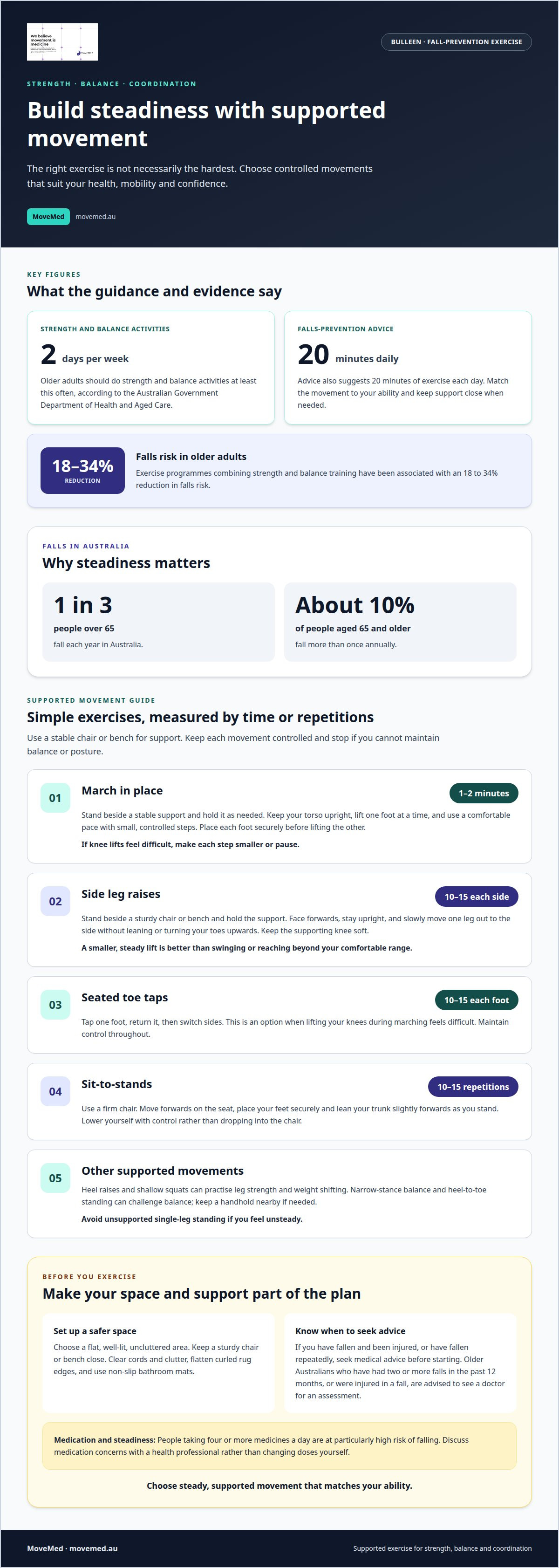
- Plan for regular practice: according to the Australian Government Department of Health and Aged Care, older adults should do strength and balance activities at least 2 days per week.
What are the Common Causes of Falls in Seniors?
Falls can follow changes in strength, health, medication use or a hazard at home. According to the Australian Government Department of Health and Aged Care, older adults should do strength and balance activities at least 2 days per week; falls-prevention advice also suggests 20 minutes of exercise daily.
Before exercising with poor balance, choose a flat, well-lit, uncluttered space and keep a sturdy chair or bench close. If you’ve fallen and been injured, or have fallen repeatedly, seek medical advice before starting.
Identify common fall causes
- Check physical and medical contributors. Reduced strength, balance or mobility can make standing and walking harder. Changes in health can also affect steadiness. People taking four or more medicines a day are at particularly high risk of falling, so discuss medication concerns with a health professional rather than changing doses yourself.
- Remove hazards from daily routes. Clear electrical cords and clutter from pathways, flatten curled rug edges, and use non-slip bathroom mats. Improve lighting on stairs and along hallways, especially at night. Supportive, well-fitting shoes with good grip can help you move more securely indoors and outside.
Recognise risk factors and warning signs
- Notice changes in steadiness. Feeling unsteady, needing a walking aid, or having a fall at home are reasons to discuss your risk of falls with a doctor. In Australia, 1 in 3 people over 65 fall each year, and about 10% of people aged 65 and older fall more than once annually.
- Act after a fall or injury. Older Australians who’ve had two or more falls in the past 12 months, or were injured in a fall, are advised to see a doctor for an assessment. A doctor can also discuss referral to an occupational therapist for home-safety recommendations if you feel unsteady or use a walking aid.
- Choose supported prevention. Falls prevention programs and classes should match your abilities. Before exercising, ask a qualified health professional about suitable movements and support. A structured, supervised program can help address balance and strength while limiting hazards, rather than relying on unsupported exercises.
How exercise supports strength, balance and coordination
Choose controlled exercises that work on strength and balance together. For seniors at high risk of falls, supported movements can be a practical starting point, such as heel raises, side leg raises and marching while holding a stable support.
Understand strength and balance training benefits
- Practise movements that build strength and steadiness. Resistance exercises work the muscles needed for walking, rising from a chair and managing stairs. Balance practice helps you control your body as your weight shifts. Exercise may also improve walking speed, balance confidence and coordination, supporting everyday mobility and making movement feel more manageable.
- Keep both kinds of training in your routine. Exercise programs combining strength and balance training have been associated with an 18 to 34% reduction in falls risk among older adults. Choose steady, supported movements rather than rushing or forcing a difficult position, particularly if arthritis or reduced mobility affects your movement.
Practise side leg raises
- Stand beside a sturdy bench or chair. Hold the support, face forwards and keep your body upright. Move one leg slowly out to the side without leaning your trunk or turning your toes upwards. This movement works muscles around the hip, which help control the pelvis during walking and other weight-bearing activities.
- Use a controlled range. Aim for 10-15 side leg raises on each side, keeping the supporting knee soft and your grip secure. Stop the movement if you cannot maintain balance or posture. A smaller, steady lift is more useful than swinging the leg or reaching beyond your comfortable range.
Use balance and functional movement exercises
- Begin with support close at hand. Try heel raises, shallow squats or marching with high knees while holding a stable bench. These movements practise leg strength and weight shifting used during daily tasks. Progress only when you can keep your steps controlled and your posture steady.
- Practise narrow-stance balance gradually. With support nearby, bring your feet closer together and stand tall. A heel-to-toe stand can challenge balance; use a handhold if needed and avoid unsupported single-leg standing if you feel unsteady. Individualised exercise guidance can help match movements to your ability and goals.
Marching in place for coordination and leg strength
Use measured movements to practise coordination and strengthen the muscles involved in everyday mobility. In Australia, supported marching, toe taps, heel raises and sit-to-stands can form practical balance exercises when matched to your ability.
March in place
- Stand beside a stable support. Hold it as needed, keep your torso upright and lift one foot at a time. March in place for 1-2 minutes, using a comfortable pace and small, controlled steps. Focus on placing each foot securely before lifting the other.
- Adjust the movement to stay steady. If lifting your knees feels difficult, make each step smaller or pause. Seated toe taps offer another way to practise alternating leg movements: tap one foot, return it, then switch sides. Aim for 10-15 repetitions on each foot, maintaining control throughout.
Strengthen legs, hips and core
- Practise sit-to-stands from a firm chair. Move forwards on the seat, place your feet securely and lean your trunk slightly forwards as you stand. Lower yourself with control rather than dropping into the chair. Repeat 10-15 times, using your hands for support if needed.
- Add heel raises for calf and ankle strength. Hold a support, rise onto your toes, pause for a few seconds, then lower your heels slowly. Repeat 10-15 times. Keep your weight balanced across both feet and avoid bouncing through the movement.
- Keep your trunk aligned during each exercise. Sit-to-stands and controlled marching ask your legs and hips to work while your body stays upright. This coordinated effort supports functional movement and independence. Stop the exercise if you cannot maintain a steady position or safely control each repetition.
Begin with the movement you can perform with the most control, then build a routine around your ability. Consistent, measured practice gives your muscles repeated opportunities to work during movements used in daily life.
Individualised fall-prevention exercise programs
For safe exercise for seniors with high fall risk in Bulleen, choose a plan based on your health, current movement and everyday goals. Practise useful activities at a manageable level, then adjust the program as your abilities or confidence change.
- Set a practical starting point. Consider which daily movements feel challenging, such as turning, standing from a chair or walking across uneven ground. Include your fall history, vision, mobility and health conditions when planning. These factors help determine suitable movements, support and pace.
- Schedule regular strength and balance practice. The Australian Government Department of Health and Aged Care recommends that older adults do strength and balance activities at least 2 days per week. Build a routine around achievable exercises, such as supported standing balance and controlled leg strengthening.
- Adapt exercises to your stability and confidence. Begin with support nearby and movements you can control. For example, practise shifting your weight while holding a bench before attempting a narrower stance. Change one part of the exercise at a time, rather than removing support and increasing difficulty together.
- Review how each movement feels. Notice changes in pain, fatigue or control while exercising. Reduce the movement range or choose an easier variation if your technique becomes unsteady. If an injury or health change affects your ability, include it when the program is reviewed.
- Consider whether exercise is enough on its own. For frailer older adults, the fall-prevention benefits of exercise alone are less certain, and other interventions may be needed. Consider strength, balance, confidence and practical hazards together when planning support.
- Seek guidance that fits your circumstances. An individual plan for safe exercise for seniors with high fall risk in Bulleen can reflect the activities you want to manage more confidently. If you’re unsure where to start, discuss your exercise goals and the movements you find difficult.
MoveMed: Exercise Physiology Consultations
MoveMed’s Exercise Physiology Consultations can help you work towards safer, more confident movement. If you have a high risk of falling, feel unsteady or aren’t sure which exercises suit your abilities, Accredited Exercise Physiologists can assess your needs and guide an individualised program.
Your plan can account for your strength, balance, health and everyday goals, then adapt as your capacity changes. This lets you practise relevant movements with guidance, rather than relying on a routine that may not match your needs. MoveMed also provides Hydrotherapy, Aged Care Funded Therapy and NDIS Funded Therapy.
Contact MoveMed to discuss exercise support for your fall-prevention goals.
Take your next step towards steadier movement
Building confidence with movement is a personal process. The most useful next step is one that fits your daily life, whether you want to feel more secure getting out of a chair, moving around your home or walking outdoors. Choose a practical goal and let it guide the exercises you work towards.
For safe exercise for seniors with a high fall risk in Bulleen, individual guidance can connect your movement goals with an exercise plan suited to your current abilities. You don’t need every detail worked out before starting a conversation. Sharing what feels difficult and what you’d like to do more comfortably can give it a clear focus.
Contact MoveMed to discuss safe exercise and take a considered step towards moving with greater confidence. Progress can begin with one achievable movement, practised with care and built on over time.
Frequently Asked Questions
Why does exercise help prevent falls in seniors?
Exercise helps by practising the physical responses used to stay upright during everyday movement. For example, stepping around an obstacle calls on leg strength, coordination and the ability to shift your weight. Repeated, appropriately challenging practice can also build confidence in movement. The right exercises depend on your health, mobility and current balance, so a routine should reflect what you need to do each day.
What balance and strength exercises are recommended for older adults to prevent falls?
Supported standing balance and controlled leg-strengthening exercises are common options for older adults. Examples include heel-to-toe standing beside a bench, sit-to-stands from a firm chair and heel raises while holding support. A suitable starting exercise depends on how steadily you can move and whether pain or another health condition affects you. If a movement is difficult to control, choose an easier variation with professional guidance.
Are there chair-based or supervised exercise programs for seniors with high fall risk in Bulleen?
Chair-based movements can offer a supported way to practise selected exercises, while supervised activity can be tailored to your needs. MoveMed’s Exercise Physiology Consultations begin with a one-on-one assessment, after which an Accredited Exercise Physiologist prescribes an exercise program. This can help identify suitable starting movements, such as seated leg activity, and adapt the plan to your balance, health and functional goals.
Where are fall-prevention exercise classes for older adults near Bulleen, Victoria?
MoveMed’s clinic is in Templestowe and serves people in Bulleen and nearby suburbs, including Templestowe Lower, Doncaster, Doncaster East, Warrandyte, Lower Plenty, Balwyn North and Box Hill. Exercise Physiology Consultations provide individually planned exercise support. If you’re looking for a class specifically, MoveMed’s exercise support is delivered through consultations rather than a group fall-prevention class.
Which Bulleen-area exercise providers offer one-to-one physiotherapy or falls assessments?
MoveMed’s Exercise Physiology programs are prescribed by Accredited Exercise Physiologists after a one-on-one assessment. Exercise physiology is distinct from physiotherapy, and MoveMed offers it as an option for tailored exercise support. An assessment can consider your movement goals and the activities you find challenging, then guide an appropriate exercise plan. MoveMed’s clinic is in Templestowe and serves the Bulleen area.
What should seniors look for when choosing a safe exercise class for fall prevention?
Look for structured strength and balance activities, clear supervision and options to adapt movements to different abilities. For instance, a program should allow an older adult to use support during standing exercises and change the movement if pain or unsteadiness affects control. Ask whether the exercises can be matched to personal goals and health needs. MoveMed’s Exercise Physiology Consultations provide an individualised alternative to a group class.


