
The best way to feel stronger after 70 may not be a single exercise. If you’re looking for the best exercise for over-70s to feel stronger in Lower Plenty, a balanced routine combining resistance exercises, balance practice and water-based activity can support strength and help you stay active.
It’s understandable to want exercises that feel safe and manageable, especially if your balance, mobility or confidence has changed. Regular physical activity can help older adults maintain muscle, flexibility and mobility, while balance work supports the stability needed for everyday movements.
Adults aged 70 and over should aim to be active every day, even if some activity is light. This guide explains how to build a practical routine, from simple strength and balance exercises to swimming or exercising in water, and how to adapt the approach to your abilities and goals.
Key Takeaways
- Practise supported balance movements to build steadiness and confidence during everyday tasks.
- Start strength work with manageable bodyweight exercises, then progress at a pace that suits your ability.
- Use household weights or resistance bands to add challenge to a simple at-home routine.
- Consider water-based activity for a lower-impact way to work your muscles and support balance.
Balance exercises and fall prevention
Balance practice works the leg and core muscles that help you stay upright. Begin with supported movements and progress only when you can control each position comfortably.
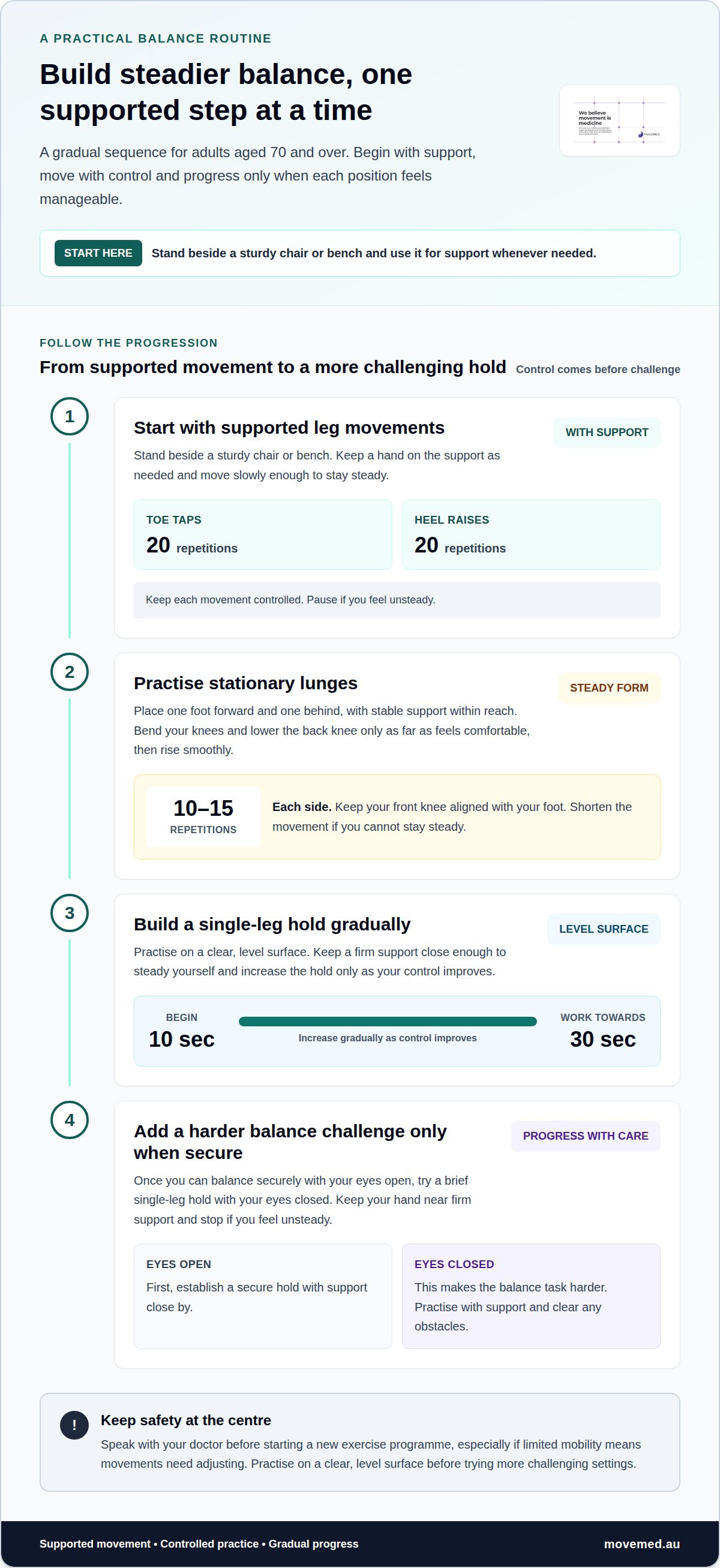
- Begin beside a sturdy bench or chair, using it for support as needed. Try toe taps, repeating the movement 20 times, then perform 20 heel raises. These exercises challenge balance while strengthening your legs. Keep your movements controlled and pause if you feel unsteady. Regular practice helps develop stability for everyday movements, such as turning or reaching.
-
Practise stationary lunges
Stand with one foot forward and one behind, keeping a stable support within reach. Bend your knees and lower the back knee until it hovers a few inches above the floor, as comfortable. Rise smoothly, then repeat for 10 to 15 repetitions on each side. Keep your front knee aligned with your foot, and shorten the movement if you cannot stay steady.
-
Add eyes-closed balance practice
Once you can balance securely with your eyes open, try a brief single-leg hold near a firm support. Keep a hand close enough to steady yourself, and stop if you feel unsteady. With your eyes closed, your nervous system relies more on signals from your muscles, joints and inner ear, making the task harder. Practise with support and keep clear of obstacles.
- Build a single-leg hold gradually, starting at 10 seconds and working towards 30 seconds as control improves. Practise on a clear, level surface before trying more challenging settings. Walking on uneven surfaces asks your balance, foot strength, vision and reaction time to work harder than walking on flat ground. Speak with your doctor before starting a new exercise programme, especially if limited mobility means movements need adjusting.
Why is physical activity so important for older adults?
Exercise physiology tailors clinical exercise; physiotherapy addresses injury and movement concerns; group fitness offers shared sessions. Seated knee lifts and supported movements can be adapted for arthritis, osteoporosis or limited mobility.
-
Start with bodyweight strength exercises
Begin with a short session of movements such as sit-to-stands, using a chair for support. A beginner’s first resistance-training session can last 10 to 15 minutes. Work towards three sets of 10 to 15 repetitions for basic bodyweight movements, keeping each repetition controlled. If your form becomes difficult to maintain, reduce the repetitions or pause before continuing.
-
Choose strength exercises
Add seated knee lifts to target your legs. Sit upright, lift one knee and the back of your thigh 2 or 3 inches off the seat, then lower it with control. Complete 8 to 12 repetitions on each leg. For another option, use wall pushups or a supported sit-to-stand. Choose a movement that suits your mobility and doesn’t force a painful range.
- Use your body weight, resistance bands or suitable household items to challenge your muscles. Older adults should strength train at least twice a week, with sessions on non-consecutive days. This spacing allows recovery between workouts. Adults aged 70 and over should also aim for some physical activity each day, even when that activity is light.
- Build a routine around movements that support daily tasks, such as standing from a chair or lifting a light household item. Regular activity can help maintain muscle strength, flexibility and mobility. Before starting a new exercise programme, discuss your health and movement needs with your doctor. Progress gradually, improving control before adding resistance or repetitions.
At-home exercise with weights and resistance bands
Weights and resistance bands add challenge to familiar movements, giving your muscles more work at home. Use controlled repetitions and progress gradually as the movements become easier.
- Choose a clear space and keep a stable chair nearby. Start with a light resistance band or household item that feels manageable to hold. Check the band for visible damage and make sure it stays secure during each movement. Smooth, controlled effort matters more than pulling harder or moving quickly.
- Try shoulder blade squeezes to work the upper back. Sit or stand tall, draw your shoulder blades gently together, and hold for 3 seconds. Repeat for 8 to 12 repetitions. Keep your shoulders relaxed rather than lifting them towards your ears. This simple movement needs no equipment, but a resistance band can add challenge to other upper-body exercises.
- Add pelvic tilts or abdominal contractions to your home routine. For pelvic tilts, gently tighten your stomach and tilt your pelvis while keeping the movement comfortable. Repeat 8 to 12 times. For abdominal contractions, draw your stomach muscles in, breathe normally, then release; repeat 10 times. Avoid holding your breath or forcing a larger range.
- Arrange the exercises as separate sets or a short circuit. You can perform three sets of 10 to 15 repetitions for each exercise, or complete 10 to 15 repetitions of each movement for three rounds. A six-minute routine offers one compact format, but allow yourself to pause when needed. Stop if your technique becomes rushed or difficult to control.
- Practise regularly, then increase the challenge gradually. For example, move to a slightly firmer band only when you can complete your current repetitions with steady control. Keep track of the band or household weight you use, the movement and how it feels. This helps you decide when to adjust the routine instead of increasing resistance automatically.
Swimming and water-based exercise
Water-based activity combines aerobic movement with resistance from the water. Swimming and pool walking can build strength while being gentle on the joints. For adults over 70 in Lower Plenty, this can be part of the best exercise plan to feel stronger.
- Choose an activity that suits your comfort and movement goals. Swimming uses repeated arm and leg movements, while walking through water can be a simpler starting point. The water resists your movement, challenging your muscles. Begin with the option you can control most comfortably.
- Try walking across the pool at a steady pace, then change direction when you feel balanced. Water resistance makes each step work your muscles, while buoyancy supports your body. Walking forwards and backwards lets you practise different movement patterns, rather than relying only on a swimming stroke.
- Use swimming or pool walking as aerobic activity. Aerobic exercise can improve circulation and lower blood pressure and heart rate. Choose a pace that lets you keep a consistent movement pattern. For example, alternate an easy pool walk with swimming, adjusting the activity to your ability.
- Include controlled movements that challenge balance as well as strength. Try stepping to the side or moving one leg while standing securely in the water. Water resistance works muscles throughout the body and provides a setting for balance practice. Focus on smooth movement rather than speed, and notice whether one direction feels harder.
- If you’re considering the best exercise for over-70s to feel stronger in Lower Plenty, water activity may suit your routine alongside land-based strength and balance work. It offers another way to move when land-based exercise feels uncomfortable. For guidance on fitting water-based exercise into your goals, discuss a suitable exercise plan.
MoveMed: Exercise Physiology Consultations
MoveMed offers Exercise Physiology Consultations to help match strength and balance exercises to your health, mobility and everyday goals. After a one-on-one assessment, an Accredited Exercise Physiologist can prescribe an individualised, evidence-based programme and adjust movements to support safe participation. This can help if you’re unsure how to progress from supported exercises, manage a health condition alongside activity or build a routine that feels right for you.
MoveMed also provides Hydrotherapy, Aged Care Funded Therapy and NDIS Funded Therapy. These services can support older adults whose needs or funding arrangements shape how they take part in exercise. Discuss your goals and movement challenges with the team to identify a suitable next step.
Contact MoveMed to discuss Exercise Physiology Consultations and your goals for staying strong and active.
Choose a next step that fits your goals
Building strength is a personal process, shaped by your health, confidence and the movements you want to manage more easily. The best exercise for over-70s to feel stronger in Lower Plenty is one you can practise consistently and adapt as your needs change. You don’t have to work out the right progression alone.
MoveMed offers Exercise Physiology Consultations, Hydrotherapy and Aged Care Funded Therapy to support your exercise goals. Discuss your circumstances and the cost of services with the team, and consider how to make movement a lasting part of everyday life.
Take the next step at your own pace. Contact MoveMed to discuss exercise and explore a path towards feeling stronger and more confident in your movement.
Frequently Asked Questions
What are the most beneficial exercises for seniors?
A mix of aerobic activity, strength work and balance practice offers a useful foundation. Walking can build cardiovascular fitness, while resistance exercises train muscles used for daily tasks. Pool walking or swimming offers another way to move. Choose activities that suit your mobility, health and goals, then build a routine you can maintain comfortably.
What types of exercise best improve strength and balance for adults over 70?
Strength exercises challenge muscles, while balance drills practise control and steadiness. For a practical combination, try sit-to-stands for leg strength and supported weight shifts for control. Pool walking adds gentle resistance as you move. Choose movements that match your current ability and focus on controlled technique rather than speed or heavier resistance.
How much strength and balance exercise is recommended for adults aged 70 and over in Australia?
A weekly routine can include at least 150 minutes of moderate aerobic activity, with strength training at least twice weekly on non-consecutive days. Aim to include balance activities as part of your exercise routine, alongside light movement on other days. You can divide aerobic activity into shorter bouts across the week to fit your energy and schedule.
What are the risks and warning signs when older adults start strength training?
Moving too quickly to harder exercises can make it difficult to maintain control and comfortable technique. Stop if a movement causes pain or leaves you feeling unsteady, and don’t push through symptoms. Before starting a new programme, discuss your health and mobility with your doctor. An exercise professional can also tailor movements to your needs.
How can someone over 70 begin a beginner strength exercise program safely at home?
Start by choosing a few simple movements that suit your mobility, such as seated knee lifts or chair-based sit-to-stands. Keep the area clear and use support if needed. Begin with an easy effort, then note which movements feel manageable and how you feel afterwards. Your doctor can advise on adjustments, and an exercise professional can help shape a suitable plan.
How do exercise physiology, physiotherapy and group fitness compare for older adults seeking to get stronger?
Exercise physiology tailors clinical exercise to an older adult’s needs; physiotherapy addresses injury and movement concerns; and group fitness provides shared sessions.


