
Imagine waking up in your Templestowe home, looking at the garden you've tended for decades, and feeling a sudden, sharp pang of worry about the front steps. For many of our neighbours in Manningham, where one in three Australians over 65 experiences a fall each year, this anxiety is a constant companion. You want to stay in the home you love, but navigating the new Support at Home system can feel like a maze. If you're searching for ways to maintain your strength and balance, understanding how to access home care package exercise physiology is the first step toward reclaiming your confidence and your front door key.
It's completely natural to feel overwhelmed by recent changes to aged care funding or confused about the difference between a physiotherapist and an exercise physiologist. You deserve clear, local guidance rather than technical jargon or endless paperwork. This guide provides a straightforward path to using your government funds for clinical exercise physiology (prescribed movement therapy to manage chronic conditions) to ensure you remain independent at home. We'll walk you through the simple process of linking your provider with MoveMed, explain the updated 2025 funding structure, and show you how restorative care can help you move with less pain and more certainty.
Key Takeaways
- Learn how home care package exercise physiology serves as a clinical foundation for maintaining your balance, strength, and safety at home.
- Understand the transition from the traditional four-level HCP system to the new Support at Home program and how it affects your allied health funding.
- Compare the benefits of different therapy environments, including specialised hydrotherapy, clinical reformer pilates, or the convenience of a home visit.
- Follow a simple step-by-step guide to identifying your mobility goals and coordinating with your case manager to begin therapy.
- Discover why a local, community-focused approach in Templestowe ensures your care is both clinically effective and personally empowering.
Aged Care Funded Therapy: EP & Your Home Care Package
You may have heard the term "exercise physiology" mentioned by your GP or case manager, but what does it actually mean for your daily life in Templestowe? Exercise Physiology (EP) is a university-qualified allied health profession. It uses evidence-based movement to treat and manage chronic medical conditions. It is clinical. It is precise. Unlike a general seniors gym class or a personal training session, EP is a prescribed medical intervention designed to keep your body capable and resilient as you age.
The Australian Government prioritises home care package exercise physiology because it is a powerful tool for preventative health. By funding these clinical services, the system aims to reduce the risk of hospitalisation and delay the transition into residential care. The ultimate goal of Aged Care in Australia is to empower you to live safely in your own home for as long as possible. Investing your funding in movement therapy is a proactive way to protect your independence and ensure you have the physical capacity to enjoy your community.
Why Exercise Physiology is Essential for Healthy Ageing
For many residents in the City of Manningham, managing long-term health conditions is a part of daily life. Statistics show that arthritis is particularly prevalent here, affecting approximately 7.9% of our local population. Clinical exercise is one of the most effective ways to manage the pain associated with arthritis and osteoporosis. It also plays a vital role in regulating blood sugar for those living with diabetes.
One of the most significant risks to independence is sarcopenia (the age-related loss of muscle mass and strength). When muscles weaken, the risk of a fall increases. Because one in three Australians over 65 experiences a fall each year, maintaining muscle mass is a clinical necessity rather than a luxury. Beyond the physical, visiting our Templestowe Lower clinic provides a vital social connection, helping to reduce the isolation that often accompanies chronic pain or mobility issues.
EP vs. Physiotherapy: Which One Do You Need?
It is common to feel confused about whether you need a physiotherapist or an exercise physiologist. While both are highly skilled, they play different roles in your health journey. Think of a physiotherapist as the specialist you see for acute injuries or "hands-on" treatment. They are experts at diagnosing a new pain and using manual therapy to help you recover from the initial stage of an injury.
In contrast, an exercise physiologist focuses on "hands-off" empowerment and long-term functional improvement. Once the acute pain is managed, the EP takes over to build the strength and stability required to prevent the problem from returning. Many of our clients find that both professions work together beautifully. A physiotherapist might settle your back pain, while your EP designs the specific movement plan that allows you to walk to the Templestowe shops without fear of your back "giving out" again.
How Home Care Package Levels Support Exercise Physiology
Accessing home care package exercise physiology depends on your current funding classification. While many Templestowe residents are familiar with the traditional four-level system, the landscape changed on 1 November 2025. The Home Care Packages Program has transitioned into the "Support at Home" model. This new structure features eight classification levels, allowing for more precise funding of clinical needs. Whether you are at Level 1 (approximately A$11,000 per year) or Level 8 (over A$78,000 per year), clinical care like exercise physiology is now fully government-funded. This means there should be no out-of-pocket costs for your essential therapy sessions.
To access this funding, your Exercise Physiology must be documented in your individualised Care Plan. This document is the agreement between you and your provider. It outlines your goals and the services you'll receive to reach them. If you want to walk to the local Templestowe shops or get in and out of your car more easily, these are the "reablement" goals that justify your funding.
Budgeting for Allied Health in Your Package
Care Managers increasingly prioritise "restorative care." This clinical approach focuses on helping you regain or maintain physical function rather than just managing decline. Because exercise physiology directly reduces falls risk, it's considered a high-value service for package longevity. It's far more effective to fund a weekly strength program than to manage the complications of a preventable injury.
For most seniors, one session per week provides the clinical momentum needed to see real results in balance and bone density. However, fortnightly sessions can still offer excellent maintenance for those with lower-level funding. If you're unsure how to approach your provider, we can help you prepare a clinical proposal that clearly outlines the benefits of EP for your specific health needs.
The 2026 Support at Home Program Transition
As we move through 2026, the transition to Support at Home is streamlining how Templestowe seniors access allied health. The new model aims to reduce the red tape that once made it difficult to adjust your services. A significant benefit of this change is the 10% cap on care management fees. This ensures that more of your budget is spent on actual clinical care.
If you are currently transitioning from an older HCP, your access to therapy is protected. The focus has shifted toward transparency, with providers now required to publish clear price schedules. This makes it easier for you to see exactly how your funds are being invested. Ensuring your goals are clearly stated now will protect your therapy funding as the system becomes more outcome-focused.
Choosing Your Setting: In-Clinic, Hydrotherapy, or Home Visits?
Where you perform your therapy can significantly influence your clinical outcomes and your motivation to continue. While home visits offer the convenience of staying in your familiar environment, they often lack the specialised tools required for advanced strength training. In contrast, our Templestowe Lower clinic provides a controlled, social space where you can connect with neighbours while working on your physical goals. When deciding how to allocate your home care package exercise physiology funding, the setting is a crucial piece of the puzzle.
Safety remains our priority in every environment. According to Exercise & Sports Science Australia (ESSA), accredited professionals must ensure that exercise environments are safe and appropriate for your specific medical needs. For home visits, we conduct a thorough assessment of your space to identify and remove potential trip hazards. However, the social benefit of visiting a local clinic shouldn't be overlooked. It turns a clinical appointment into a meaningful community interaction, which is vital for mental health and long-term resilience.
The Benefits of Clinical Reformer Pilates for Seniors
We often recommend clinical reformer pilates in Templestowe for clients who need to improve core stability without putting excessive strain on their joints. The reformer machine uses adjustable springs for resistance, providing a supportive way to build muscle mass and improve posture. It's particularly effective for seniors with chronic pain or limited mobility, as we can adapt every movement to your comfort level. This isn't just about general flexibility. It's about building the deep stability that keeps you upright and steady during your daily walk to the shops.
Hydrotherapy: The Low-Impact Alternative
If arthritis or joint pain makes land-based movement feel impossible, hydrotherapy for seniors in Templestowe Lower is an excellent alternative. The buoyancy of the water supports up to 90% of your body weight. This takes the pressure off your hips and knees, allowing for a wider range of motion with significantly less pain. The warmth of the pool also helps to soothe aching muscles and improve circulation. Many home care package exercise physiology plans fully fund these aquatic sessions because they facilitate movements that are often too painful to perform on land, helping you maintain your independence for longer.
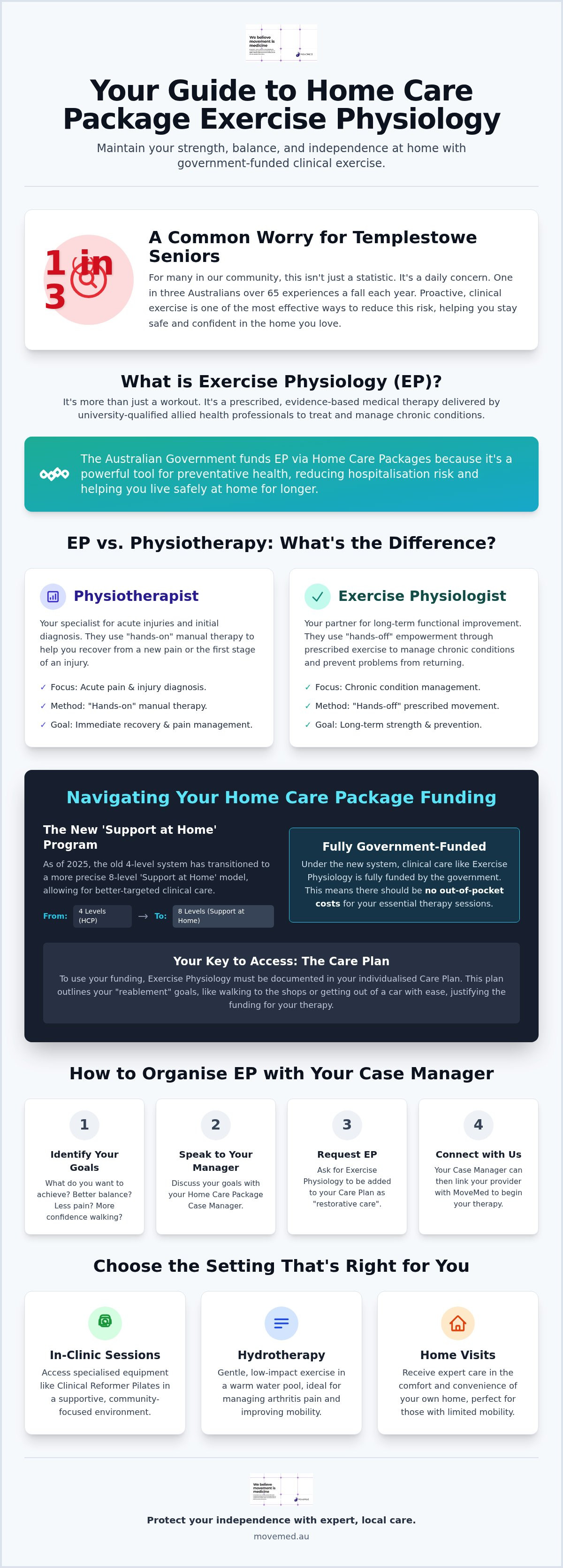
Step-by-Step: How to Organise EP with Your Case Manager
Navigating the bureaucracy of My Aged Care can feel like a full-time job. You shouldn't have to be an expert in government policy just to get the support you need to stay active. Organising home care package exercise physiology is actually a straightforward process when you have the right clinical partner to guide you. We've broken the journey down into five manageable steps to help you move from feeling overwhelmed to feeling empowered.
- Step 1: Identify your goals. Think about what you want to achieve. Do you want to walk to the Templestowe shops safely? Do you want to be able to get down on the floor to play with your grandchildren? Specific goals make it easier for your provider to approve the funding.
- Step 2: Contact MoveMed for a clinical proposal. We'll sit down with you to understand your medical history and physical needs. We then create a formal quote and a clinical proposal that outlines exactly why exercise physiology is necessary for your health.
- Step 3: Present the proposal to your Case Manager. Send our proposal to your Home Care Package provider. Because we use clinical language that aligns with government requirements, Case Managers can quickly see the value of the service.
- Step 4: Sign the Service Agreement. Once your provider approves the budget, we'll send you a Service Agreement. This document clearly outlines the frequency of your sessions and ensures all costs are covered by your package.
- Step 5: Regular reviews. We don't just set and forget. We provide regular progress reports to your provider, documenting how your strength and balance are improving. This evidence helps justify your ongoing funding.
To get started on your clinical proposal, book your initial clinical consultation with our Templestowe team today.
What to Say to Your Home Care Provider
When you speak with your Case Manager, using the right terminology can speed up the approval process. Focus on phrases like "evidence-based falls prevention" and "restorative care." These terms signal to the provider that you are looking for a clinical intervention that will reduce your long-term care needs. If your current budget is fully allocated to other services like cleaning or gardening, ask for a "budget reallocation." Remind them that improving your physical capacity now will reduce the need for more intensive (and expensive) support services in the future.
Self-Managed vs. Provider-Managed Packages
If you have a self-managed package, you have the greatest freedom to choose your own Exercise Physiologist. You can partner with MoveMed directly and we will handle the invoicing according to your instructions. For those with provider-managed packages, we have extensive experience working with major providers like Australian Unity and MyLife. We streamline the administrative side of your home care package exercise physiology by coordinating directly with their finance teams. This ensures your sessions are paid for automatically, so you never have to worry about out-of-pocket expenses or complicated reimbursement forms.
Why Templestowe Seniors Choose MoveMed for Funded Therapy
Choosing a provider for your home care package exercise physiology is a deeply personal decision that goes beyond clinical qualifications. You want a team that understands the hills of Templestowe and the specific needs of our Manningham community. At MoveMed, we don't see you as a patient file. We see you as a neighbour who wants to keep gardening, walking the dog along the Yarra, or simply moving around the house without the constant fear of a fall. Our commitment to local health outcomes is driven by the belief that every resident deserves to age with dignity and strength.
Our approach, which we call the "MoveMed Way," balances clinical authority with deep empathy. We know that chronic pain or a recent diagnosis can feel like a loss of agency. Our role is to act as your knowledgeable guide, handling the complicated coordination with your package provider so you can focus entirely on your physical progress. By integrating Exercise Physiology Consultations with specialised options like hydrotherapy and clinical pilates, we create a path to independence that is as unique as your own health journey. Convenience matters when you are managing mobility challenges. Our Templestowe Lower clinic is designed with local seniors in mind, offering easy access and stress-free parking. You won't have to navigate a busy shopping centre car park just to reach your appointment.
Expert-Led Strength and Balance Programmes
We place a heavy emphasis on strength training for seniors in Templestowe because muscle mass is the primary insurance policy against frailty. Our Accredited Exercise Physiologists (AEPs) are specialists in aged care. They understand the nuances of osteoporosis, heart health, and joint replacements. We've seen local residents reclaim their mobility after being told they might need to consider assisted living, proving that with the right clinical support, your best years of movement can still be ahead of you. These success stories are what drive us to provide the highest standard of care in the Manningham region.
Getting Started Today
You don't need a GP referral to start the conversation with us. While we often work alongside doctors, you can reach out directly to begin using your home care package exercise physiology funding. We usually start with a low-friction "meet and greet" or an initial clinical consultation. This allows us to assess your needs and explain the process in plain English before any paperwork is signed. It's never too late to start moving better. Whether you're recovering from a surgery or simply notice that you're feeling less steady on your feet, we're here to partner with you on the journey back to confidence.
Reclaiming Your Independence Starts with a Single Step
Staying in your own home is about more than just a familiar address; it's about the freedom to move through your life with confidence. We have explored how the new Support at Home system prioritises restorative care and how you can navigate the bureaucracy to access the funding you deserve. By integrating home care package exercise physiology into your weekly routine, you're making a long-term investment in your safety and quality of life. Whether you choose the buoyancy of hydrotherapy or the targeted strength of clinical pilates, the goal remains the same: keeping you capable, resilient, and independent.
You don't have to manage this journey alone. Our Accredited Exercise Physiologists at our local Templestowe Lower clinic are experts in aged care and are ready to help you coordinate with your provider. As an NDIS and aged care registered provider, we take the stress out of the paperwork so you can focus on your progress. Taking that first step toward better balance and less pain is simpler than you might think. We invite you to Book a Consultation with a MoveMed Exercise Physiologist today. Let's work together to ensure you can continue to enjoy everything our Manningham community has to offer for years to come.
Frequently Asked Questions
Is Exercise Physiology covered by all Home Care Package levels?
Yes, clinical exercise physiology is accessible across all funding levels under the current Australian aged care system. Whether you are classified at Level 1 or Level 8 in the new Support at Home program, clinical care is fully government-funded. This ensures that every senior has the opportunity to maintain their strength and balance regardless of their specific package tier.
Do I need a referral from my GP to use my package for EP?
No, you do not strictly require a GP referral to begin using your package funds for exercise physiology. You can contact us directly to start the conversation and organise an initial consultation. While a referral isn't mandatory, we often work closely with your local doctor to ensure your movement programme is perfectly aligned with your broader medical history and health goals.
Can MoveMed come to my home in Doncaster or Bulleen?
Yes, our team provides home visit services throughout the Manningham region, including the suburbs of Doncaster and Bulleen. This is a practical solution if you find it difficult to travel or if you prefer to exercise in a familiar environment. During our first visit, we'll perform a brief safety assessment of your space to ensure we can conduct your therapy sessions safely and effectively.
How much of my package budget will Exercise Physiology use?
The impact on your budget depends on the frequency of your sessions, but clinical care is now a prioritised funding category. Under the Support at Home model, clinical services like allied health are fully funded by the government, meaning they shouldn't take away from your budget for domestic assistance. We provide your Case Manager with a transparent clinical proposal so you know exactly how your funds are being utilised.
What is the difference between a gym instructor and an Exercise Physiologist?
An Exercise Physiologist is a university-qualified allied health professional with the clinical expertise to prescribe movement as a medical intervention. Unlike a general gym instructor, an EP understands the complexities of chronic conditions like osteoporosis or heart disease. They are considered the gold standard for home care package exercise physiology because they provide safe, evidence-based care tailored to your specific medical needs.
Can I use my package for both Hydrotherapy and Clinical Pilates?
Yes, you can certainly use your funding for a combination of different therapy types if they support your documented health goals. Many of our Templestowe clients find that a mix of hydrotherapy for joint pain and clinical pilates for core stability provides the best results. We can help you structure a balanced programme that incorporates various settings to keep your rehabilitation engaging and effective.
What happens to my EP funding when the Support at Home program starts in 2026?
Your access to clinical therapy is protected during the transition to the Support at Home program throughout 2026. The new system is designed to streamline access to allied health, making it easier for you to receive the care you need. If you are already using home care package exercise physiology, your funding will remain secure as the government shifts toward a more restorative, outcome-focused model of care.
How do I switch my therapy provider to MoveMed if I'm already with someone else?
Switching your therapy provider is a simple process that your Case Manager or provider can facilitate at your request. You have the right to choose the clinical team that best fits your needs and location. Simply inform your current provider that you would like to transition your exercise physiology to MoveMed, and we will handle the rest of the administrative coordination and service agreements for you.


