
Did you know that 3.6 million Australians are currently living with chronic pain? If you're one of them, you likely feel like a broken record at the doctor's office while searching for effective chronic pain management techniques. You might find yourself stuck in a frustrating "boom and bust" cycle, where a productive morning in the garden leads to three days of total bed rest. It's exhausting to feel like your own body is a minefield where every movement might cause more damage. You want to move, but the fear of a flare-up keeps you stationary.
We believe that managing persistent pain is about more than just "getting through the day." It's about retraining a sensitive nervous system to feel safe again. We'll show you how evidence-based strategies shift the focus from "fixing" a single body part to empowering the whole person. Our goal is to help you reclaim your independence and confidence through clinical movement that respects your limits while building your resilience over the long term.
This article provides a practical self-care checklist designed to lower the intensity of your flares and help you understand the vital role of pacing. We'll explore how to structure your recovery so you can return to walking the dog or enjoying the local park with a clear, manageable path forward.
Key Takeaways
- Understand why your brain keeps the "pain alarm" turned up and how you can begin to dial the volume back down through graded exposure.
- Discover how addressing sleep, stress, and social connection can help lower the intensity of your pain signals using a whole-person approach.
- Learn practical chronic pain management techniques that allow you to reintroduce movement safely without the fear of causing further damage.
- Master the "pacing" method to treat your energy like a bank account and finally break the exhausting "boom and bust" cycle.
- Identify how a personalised plan from an Exercise Physiologist can help you transition from simply managing symptoms to reclaiming your daily activities.
What is Chronic Pain? Understanding the Sensitive Nervous System
Chronic pain isn't just a symptom that hasn't gone away. It's a fundamental shift in how your body processes information. While acute pain acts like a smoke alarm warning you of an immediate fire, persistent pain is like an alarm system that has become so sensitive it triggers when a moth flies past the sensor. This doesn't mean the alarm isn't loud or distressing. Your pain is 100% real. However, the volume of the signal no longer matches the state of your tissues. By the time pain becomes chronic, which is generally defined as lasting longer than three months, the original injury has often healed, yet the brain continues to produce a protective response.
Applying effective chronic pain management techniques involves understanding that your nervous system is essentially trying to keep you safe, albeit too enthusiastically. The brain is the ultimate gatekeeper of your experience. If it perceives a threat, it turns up the volume on pain to stop you from moving. In chronic cases, this "threat" perception stays active long after the physical danger has passed. This creates a cycle where the body becomes hyper-vigilant, reacting to normal sensations as if they were harmful.
The Science of Central Sensitisation
This heightened state of sensitivity is known as central sensitisation. Think of it as your nervous system "learning" to be in pain. Because our brains are plastic, meaning they can change and adapt, they can become very efficient at producing pain signals. Small triggers, like a change in weather or a minor stressful event, can cause large flare-ups because the system is already primed for a reaction. Modern pain management research suggests that we need to look beyond the physical tissues and address this entire neurological loop. The good news is that because the system learned to be sensitive, it can also learn to be resilient again through neuroplasticity.
Why Traditional "Rest" Often Fails
When we're in pain, our natural instinct is to stop moving. While this is helpful for a broken bone, total rest is often the enemy of chronic pain recovery. Long-term inactivity leads to deconditioning, where muscles weaken and joints become stiff. This actually lowers your pain threshold, making it even easier for the "alarm" to go off during simple tasks. This often leads to fear-avoidance, where you stop doing things you love because you're worried about causing damage.
Effective chronic pain management techniques move away from total rest and toward "Movement is Medicine." Instead of waiting for the pain to disappear completely before you start moving, we focus on finding your "baseline." This is the amount of activity you can do safely without causing a major flare. By slowly and gently increasing this baseline, we show your nervous system that movement is safe, eventually turning the volume of that alarm system back down.
The Biopsychosocial Model: A Whole-Person Approach
Modern healthcare has moved away from looking only at the physical "plumbing" of the body. The biopsychosocial model is the holistic framework for 2026 health standards that recognises pain as an intersection of your body, mind, and environment. This approach acknowledges that while your pain is felt in the tissues, the intensity of that experience is shaped by your entire life context. By addressing all three pillars, we can create a more resilient foundation for long-term relief.
We often see the best results when people use a multidisciplinary team. This is the gold standard for chronic pain management techniques. It involves your GP, a psychologist, and an Exercise Physiologist working in tandem to support your goals. Instead of chasing the elusive goal of "zero pain," we focus on improving your function and quality of life. When you can return to the activities you love, the pain often becomes a smaller, more manageable part of your day.
Biological Factors Beyond the MRI
Scan results don't always tell the whole story. It's common for an MRI to show a bulging disc in a person with zero symptoms; conversely, someone might experience debilitating pain despite a perfectly "clean" scan. This happens because biological factors like systemic inflammation, nutrition, and sleep hygiene play massive roles in how your nervous system interprets signals. Poor sleep, for instance, acts as a volume knob. It makes your brain more reactive to minor stimuli that it might otherwise ignore. Addressing these lifestyle factors is a vital part of calming a sensitive system.
Psychological and Social Influences
Our thoughts and social connections are just as physical as our muscles. Anxiety can lead to "catastrophising," which is a clinical term for assuming a flare-up means permanent damage. This mental state keeps the body in a high-alert mode, which actually increases pain sensitivity. Research into complementary health approaches for chronic pain highlights how mind-body strategies can calm this response.
Social isolation is another known pain amplifier. Returning to a hobby, such as a local gardening group or a walking club, provides a powerful distraction and releases chemicals that naturally dampen pain signals. Understanding what is Exercise Physiology can help you see how a movement expert integrates these social and psychological goals into your recovery. If you're feeling overwhelmed by where to start, you can speak with our team to help organise a plan that fits your lifestyle.
The Clinical Movement Checklist: How to Start Moving Again
Generic health advice often suggests "staying active" as a cure-all. However, if you are living with a sensitive nervous system, a standard 30-minute walk can feel like an impossible mountain to climb. The key to successful chronic pain management techniques is finding your specific "starting line", which is the level of activity that feels safe to your brain. We focus on consistency rather than intensity. It's better to move for two minutes every day than to push for an hour once a week and suffer a major flare-up afterward. By starting small, you prove to your nervous system that movement isn't a threat.
Your Daily Movement Checklist
Think of this checklist as a way to "check in" with your body before you ramp up your activity. By following these steps, you provide your brain with the safety signals it needs to lower its protective guard and allow for more fluid motion.
- Check 1: Breathwork. Start with three minutes of diaphragmatic breathing (belly breathing). This physically signals your nervous system to down-regulate, shifting you from a state of high alert into a calmer, more receptive mode.
- Check 2: Gentle Mobility. Use rhythmic, supported movements to lubricate your joints and warm up your muscles. Many of our clients find that Clinical Reformer Pilates is an ideal way to explore movement because the machine supports your body weight while you build strength.
- Check 3: Graded Exposure. Do a little bit more than yesterday, but only by a tiny fraction. If you can walk for two minutes comfortably, try two minutes and thirty seconds. This slow progression "retrains" your brain to accept movement as safe.
Low-Impact Options for Sensitive Systems
If land-based exercise feels too heavy or intimidating, Hydrotherapy is often considered a "cheat code" for persistent pain. The buoyancy of the water supports your joints and removes the load of gravity, while the warmth helps to soothe muscle tension and improve circulation. It allows you to perform movements in the pool that might be too painful to attempt on solid ground. This environment provides a unique opportunity to build confidence in your body's capabilities without the fear of immediate repercussions.
Working with an Exercise Physiologist ensures you don't overstep your limits during this process. We use a "traffic light" system to help you judge your pain during activity. A "green light" is a dull ache that doesn't worsen as you move; this is generally safe. A "yellow light" means the pain is noticeable but manageable, suggesting you should stay at that level. A "red light" is sharp, stabbing, or escalating pain that lingers for hours. If you hit a red light, it's a signal to stop, rest, and reassess your baseline with your movement coach.
Self-Care and Pacing: Breaking the "Boom and Bust" Cycle
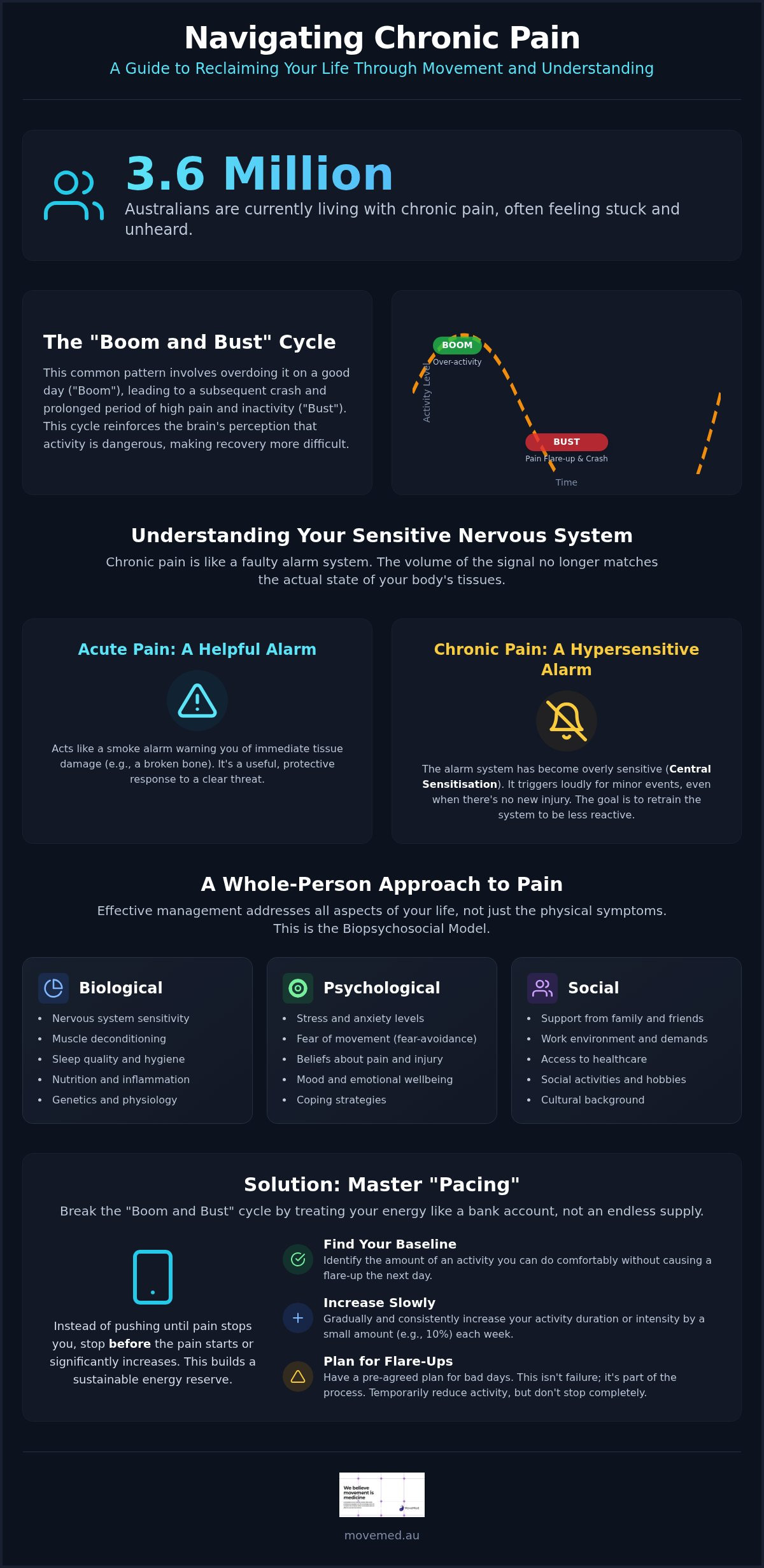
Many Australians living with persistent pain fall into a frustrating pattern known as the "Boom and Bust" cycle. On a "good day" when the pain feels manageable, you might try to catch up on everything. You might clean the whole house, finish the grocery shopping, or spend hours in the garden. While this feels productive at the time, it often leads to a "bust" where you're forced into days of bed rest to recover. This cycle is exhausting. It actually reinforces the brain's belief that activity is dangerous. Breaking this habit is one of the most powerful chronic pain management techniques you can master.
Think of your daily energy like a bank account. If you spend your entire balance by lunchtime, you'll be overdrawn by evening. The "interest" you pay is a significant flare-up. Effective self-care involves learning to spend your energy in small, controlled increments. Instead of waiting for pain to tell you to stop, you should set time-based limits. Stopping while you still feel okay helps keep your nervous system in a state of safety. This prevents you from pushing into a protective "alarm" phase. We want to focus on restorative rest, which is a planned break to recharge, rather than avoidant rest, which is a fearful reaction to a flare-up.
The Pacing Strategy for Daily Tasks
Practical pacing isn't about doing less. It's about doing things differently. Try breaking your larger chores into 10-minute "chunks" followed by a short period of restorative rest. For example, spend ten minutes hanging out the washing, then sit quietly for five minutes before moving to the next task. Pacing is the deliberate act of distributing activity and rest to prevent nervous system overload. You can use a simple traffic light system to plan your day. "Green" tasks are light, like reading. "Yellow" tasks are moderate, like cooking. "Red" tasks are demanding, like vacuuming. Aim to never do two "red" tasks back-to-back.
Sleep and Stress Management
Your internal "pain gate" in the spinal cord is heavily influenced by your stress levels and sleep quality. When you're sleep-deprived, this gate stays open. This allows more pain signals to reach the brain. Simple relaxation techniques, such as progressive muscle relaxation or mindfulness, can help close this gate by lowering your overall cortisol levels. It's also vital to have a "Flare-up Plan" ready. Knowing exactly what to do when pain increases reduces the panic that often makes flares feel worse. This plan might include using heat packs, gentle breathwork, or a specific clinical movement. If you need help creating a structured plan for your recovery, you can book an Exercise Physiology consultation with our team today.
Building Your Support Team in Melbourne’s East
While at-home strategies are a vital foundation, navigating the complexities of a sensitive nervous system often requires a specialised guide. Transitioning from self-care to professional clinical guidance allows you to refine your chronic pain management techniques with expert precision. At MoveMed, our Accredited Exercise Physiologists in Templestowe Lower act as your movement coaches, helping you bridge the gap between where you are now and where you want to be. We understand that your journey is unique, which is why our approach is deeply empathetic, evidence-based, and firmly rooted in our local community.
Working with a professional provides the objective feedback needed to progress safely. When you're in pain, it's difficult to know if a sensation is a "safe" ache or a warning sign to stop. Our team helps you interpret these signals, ensuring you build resilience without the fear of a major setback. We don't just give you a list of exercises; we partner with you to build a lifestyle that supports movement, confidence, and long-term relief.
Funding Pathways for Pain Management
Navigating the Australian healthcare system can feel overwhelming, but there are several pathways designed to make clinical support accessible. For those with a condition present for six months or more, a GP-managed Chronic Disease Management (CDM) Plan can provide Medicare rebates for up to five allied health services per calendar year. This is a practical way to start your journey with an Exercise Physiologist while managing the costs of care.
- NDIS Funding: If you're an NDIS participant, you may be able to access Exercise Physiology under "Improved Daily Living" or "Health and Wellbeing" categories to support your functional goals.
- TAC and WorkCover: For those recovering from transport or workplace accidents, we provide structured programmes to help you return to work and daily life safely.
- DVA Support: We also work closely with veterans through DVA-funded programmes to manage service-related injuries and persistent pain.
Next Steps: Your First Clinical Consultation
Your first session at MoveMed is about understanding your story. We perform a comprehensive assessment that looks at your movement patterns, your pain history, and your specific goals, whether that's returning to the golf course or simply playing with your grandkids. This assessment forms the basis of your personalised plan, ensuring every movement we prescribe is safe for your sensitive system. Our specialised focus on Injury Rehabilitation Templestowe Lower ensures you receive local, expert care in a supportive environment.
You don't have to manage this journey alone. By combining your at-home self-care with professional expertise, you can finally move past the "broken record" stage and start seeing tangible progress. When you're ready to take the next step toward reclaiming your independence, we're here to help you start your movement journey with confidence.
Your Path to Reclaiming Movement
Living with persistent pain can feel like an endless battle, but it doesn't have to stay that way. By understanding that your nervous system is simply over-sensitive, you can begin to use chronic pain management techniques that focus on safety and gradual progress. Remember that pacing your daily tasks and choosing movements that feel "safe" are the keys to breaking the boom and bust cycle for good.
You don't need to navigate this journey alone. At MoveMed, our Accredited Exercise Physiologists specialise in helping people just like you find their movement baseline. We're a registered NDIS and TAC provider located right in the heart of Templestowe Lower, dedicated to providing the community-focused care you deserve. Whether you're looking to return to your garden or simply walk the dog without fear, we're here to partner with you every step of the way.
Ready to start your recovery? Book a Clinical Consultation at MoveMed Templestowe Lower and let's build your personalised plan together. You have the power to retrain your system and reclaim your independence. We're looking forward to being part of your success story.
Frequently Asked Questions
Is exercise safe if I have chronic back pain?
Exercise is not only safe but often considered the most effective long-term treatment for chronic back pain. While you might fear that movement causes damage, research shows that controlled, clinical movement strengthens the muscles supporting your spine and desensitises your nervous system. The key is starting at a level that doesn't trigger a massive flare-up. We focus on gentle, rhythmic motions that build your confidence and physical resilience.
Can chronic pain ever truly go away?
While the goal for many is total elimination, modern medicine focuses on lowering the volume of pain signals and improving your daily function. Many people find that by using consistent chronic pain management techniques, their pain reduces to a background hum that no longer prevents them from enjoying life. Through neuroplasticity, your brain can unlearn some of these persistent signals, leading to significant and lasting relief over time.
How is an Exercise Physiologist different from a Physiotherapist for pain?
An Accredited Exercise Physiologist specialises in using clinical exercise as medicine to treat chronic conditions and complex injuries. While other practitioners might focus on short-term manual therapy or hands-on treatments, an EP focuses on long-term functional movement and lifestyle modification. We act as movement coaches who guide you through a structured, exercise-based recovery plan designed to build lasting strength, confidence, and independence.
What is the "Boom and Bust" cycle in pain management?
The "Boom and Bust" cycle occurs when you overexert yourself on days when your pain is low, leading to an inevitable flare-up and days of total rest. This pattern is counterproductive because it keeps your nervous system in a state of high alert. Learning to pace your activities helps you maintain a steady level of activity without crashing, which eventually helps to lower your overall pain sensitivity.
Does the NDIS cover exercise physiology for chronic conditions?
Yes, the NDIS often covers Exercise Physiology under the "Improved Daily Living" or "Health and Wellbeing" support categories. If your chronic condition significantly impacts your ability to perform daily tasks, you can use your funding to work with an Accredited Exercise Physiologist. We help you navigate these requirements to ensure you get the therapeutic support needed to improve your independence and quality of life in the long term.
How long does it take to see results from movement therapy?
Most people begin to feel a shift in their pain perception within four to six weeks of consistent, gentle movement. However, retraining a sensitive nervous system is a gradual process that requires patience. Significant improvements in physical strength and functional capacity typically take three to six months. We focus on small, sustainable wins that build up over time to create a more resilient body and mind.
What should I do during a major pain flare-up?
During a major flare-up, your first step is to stay calm and remind yourself that a flare does not mean new damage has occurred. Use your pre-planned flare-up strategies, such as diaphragmatic breathing, heat packs, or very gentle mobility exercises. Avoid total bed rest, as this can stiffen your joints and prolong the episode. Instead, try to maintain a very low level of safe movement to keep your system regulated.
Can hydrotherapy help with fibromyalgia or widespread pain?
Hydrotherapy is exceptionally effective for widespread conditions like fibromyalgia. The warmth of the water helps to soothe sensitive nerves and relax tight muscles, while buoyancy reduces the impact on your joints. This weightless environment allows you to perform chronic pain management techniques that might feel too difficult on land. It provides a safe space to rebuild movement confidence without the usual heavy load on your nervous system.


