
Could gentle exercise for PTSD after transport accident Lower Plenty help you move at a pace that feels manageable? After a crash, exercise settings or certain movements may feel unsettling, and it’s understandable to worry about worsening distress or physical symptoms. You don’t have to push through those concerns to explore movement.
Recovery-focused exercise starts with safety, choice and individual pacing. An Accredited Exercise Physiologist can discuss your goals, comfort and physical limitations, then help you consider suitable movement options. Exercise physiology isn’t psychological therapy or a replacement for trauma-focused mental health care, but it may form part of a broader recovery plan.
This article explains how gentle, individually paced movement may fit into recovery, what to ask an exercise professional before starting, and how TAC funding may be relevant if your circumstances meet current requirements. MoveMed provides exercise physiology consultations and TAC-funded therapy for people in Lower Plenty and nearby communities, including Templestowe Lower, Templestowe, Doncaster, Doncaster East, Bulleen, Warrandyte, Balwyn North and Box Hill. Take your time to consider whether a conversation with an Accredited Exercise Physiologist feels like a useful next step.
Key Takeaways
- Gentle exercise means movement adapted to your comfort and needs, not a fixed routine or a test of willpower.
- An Accredited Exercise Physiologist can discuss your goals, physical capacity and movement preferences with you.
- Ask how an exercise professional adapts a plan and responds if movement feels uncomfortable or distressing.
- Compare options such as walking, gentle mobility and water-based exercise with a clinician before deciding what may suit you.
- Explore gentle exercise for PTSD after transport accident Lower Plenty, including whether TAC funding may apply to your circumstances.
Gentle exercise for PTSD after transport accident Lower Plenty: what it can and cannot offer
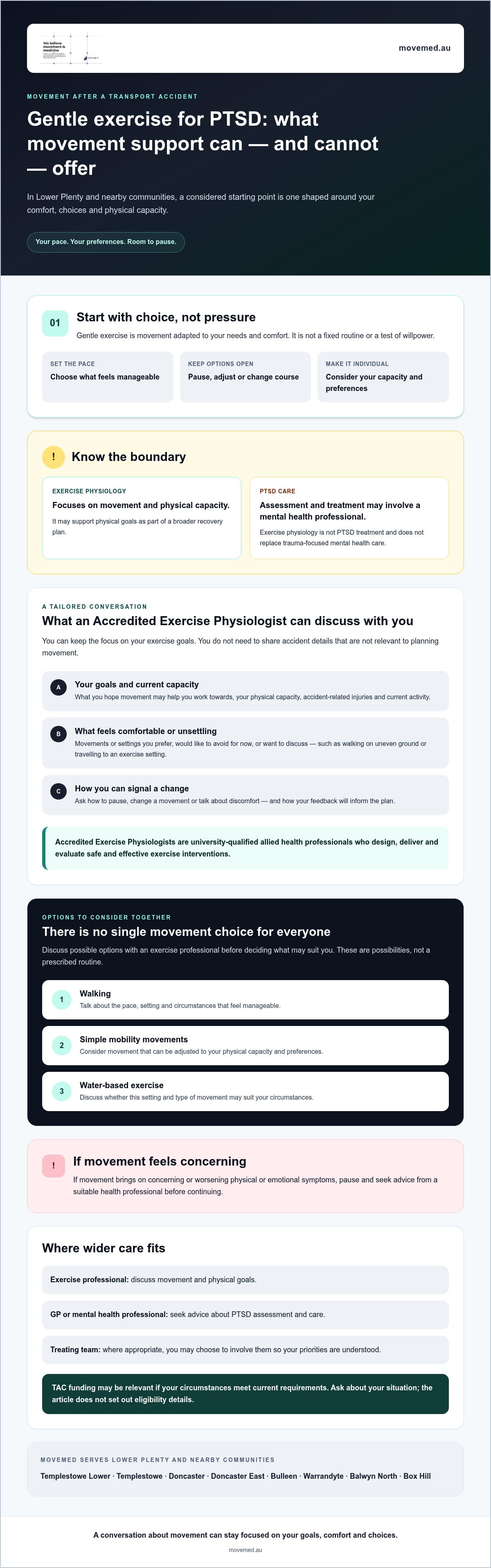
After a transport accident, movement may feel unfamiliar, uncomfortable or emotionally difficult. Gentle exercise isn’t a standard routine you need to follow or a test of willpower. It means movement that is considered and adjusted to your physical capacity, preferences and circumstances, with room to pause or change course.
Exercise physiology focuses on movement and physical capacity. It may help you work towards physical goals, but it shouldn’t be presented as a way to prevent, treat or resolve PTSD. Post-traumatic stress disorder is a mental health condition that can follow traumatic experiences, including traffic collisions. Assessment and treatment for PTSD may involve a mental health professional.
That distinction can help you decide what support to seek. Supportive movement and trauma-focused mental health treatment have different purposes, and one doesn’t replace the other. If you’re exploring gentle exercise for PTSD after transport accident Lower Plenty, consider exercise physiology as one possible part of your wider care, not a stand-alone response to trauma.
What does gentle movement mean after trauma?
There’s no single activity that feels gentle or safe for everyone. Depending on your needs and preferences, you might discuss walking, simple mobility movements or water-based exercise with an exercise professional. These are options to consider together, not a prescribed routine. You can discuss the pace, setting and type of movement, and explain what feels manageable or unsettling.
When should exercise sit alongside other care?
An Accredited Exercise Physiologist can work with you on physical goals, while a GP or mental health professional can advise on PTSD assessment and care. Where appropriate, you may choose to involve your existing treating team so everyone understands your priorities. If movement brings on concerning or worsening physical or emotional symptoms, pause and seek advice from a suitable health professional before continuing.
In brief: Exercise physiology may support physical capacity through tailored movement. It isn’t PTSD treatment and doesn’t replace care from a mental health professional.
How an Accredited Exercise Physiologist can tailor movement in Lower Plenty
A useful starting point is a conversation about what you want movement to help you do and what feels manageable right now. An Accredited Exercise Physiologist can consider your physical capacity, accident-related injuries, current activity and preferences when discussing possible next steps. You might focus on practical goals, such as building confidence with everyday movement or working towards an activity you miss. You don’t need to share accident details that aren’t relevant to planning exercise.
Accredited Exercise Physiologists are university-qualified allied health professionals who design, deliver and evaluate safe and effective exercise interventions. Their role is to guide exercise for physical health and function. They aren’t a substitute for a mental health professional, and a discussion about exercise doesn’t need to become a discussion about trauma treatment.
Some guidance on physical activity and PTSD, including from the U.S. Department of Veterans Affairs, discusses potential benefits for physical and mental health. Read Exercise can improve both physical and mental health as general information, not as a guarantee that exercise will change your PTSD symptoms. Your circumstances and response matter.
What might the first discussion cover?
Before an appointment, you could note which movements or situations feel comfortable, which you’d prefer to avoid for now, and what you hope to return to. For example, you might want to discuss walking on uneven ground, travelling to an exercise setting or managing pain during activity. Ask what information the practitioner needs and whether you can keep the discussion focused on your exercise goals. You can also ask what choices may be available if you feel uneasy.
How can sessions remain choice-led?
Before starting an activity, ask how you can signal that you’d like to pause, change the movement or discuss discomfort. Share feedback as you go, and ask how it will inform the plan. The approach can be reviewed when your capacity, goals or comfort change. It doesn’t need to stay fixed simply because it was the first option discussed.
If you’re considering gentle exercise for PTSD after transport accident Lower Plenty, an initial conversation with MoveMed’s Accredited Exercise Physiologists may help you explore whether exercise physiology suits your physical goals and preferences. You could learn about MoveMed’s exercise physiology and ask about suitable next steps. If you have a GP or treating team, you may also choose to discuss how exercise support could fit alongside your care.
Choosing a safe starting point: questions to ask before you begin
Before deciding whether exercise physiology feels right for you, prepare questions that help you understand the clinician’s approach and the choices available to you. You can share relevant physical symptoms, current care and movement concerns without feeling that you need to explain more than is useful for planning exercise.
Evidence about exercise and PTSD is still developing, and research can’t guarantee a particular outcome. The U.S. Department of Veterans Affairs summarises research on the benefits of exercise for PTSD, including exercise as a possible complementary approach. Discuss whether movement is suitable for your situation with a qualified health professional, particularly if you have accident-related injuries or other health concerns.
Questions about the clinician and the plan
These prompts can help you start a practical conversation with an Accredited Exercise Physiologist:
- How will you adapt movement to my goals, physical capacity and feedback? You could name an everyday activity you hope to manage more comfortably.
- What can I do if an activity feels uncomfortable or distressing? Ask how you can pause, change the activity or talk through your concerns.
- How might you coordinate with my GP or treating team? If you’re receiving other care, ask how you can involve those clinicians where relevant.
- How will we review whether the plan still suits me? Your needs or goals may change, so ask how you can raise that and discuss adjustments.
You can share concerns about pain, fatigue, movement or situations that feel difficult. You don’t need to push through discomfort to prove you’re trying. If symptoms become concerning or worsen, pause and seek advice from an appropriate health professional before continuing.
Questions about TAC and practical arrangements
If you’re considering gentle exercise for PTSD after transport accident Lower Plenty, check funding and practical arrangements before making assumptions. MoveMed supports TAC clients, but whether exercise physiology is funded depends on your circumstances and current TAC arrangements. Confirm your eligibility, any approvals and funding directly with TAC or your treating team. Ask MoveMed about current service availability and appointment arrangements for Lower Plenty, and what information you may need to discuss before getting started.
Gentle exercise options after a transport accident: match the approach to you
There’s no single setting or activity that suits everyone after a transport accident. A familiar home space may feel easier for one person, while another may prefer guidance from a clinician. Noise, crowds, privacy, travel and physical symptoms can all affect what feels manageable. Use the options below as prompts for a conversation, not as a prescribed routine.
How to compare movement settings
| Option to discuss | What to consider | Questions to ask |
|---|---|---|
| Walking at home or in the community | Route, surfaces, traffic, other people and how easy it is to stop or turn back. | Would a familiar, quieter route feel more manageable? What should I consider given my injuries or symptoms? |
| Gentle mobility in a familiar space | Privacy, room to move and whether the movements suit your physical needs. | Which movements could I discuss with you? How can I change or pause one if it feels uncomfortable? |
| Supervised exercise setting | Travel, noise, crowding, privacy and the level of guidance available. | What is the setting like, and how can I tell you if I need a break or a change? |
| Water-based exercise | Comfort around water, access, changing facilities and any relevant health considerations. | Could hydrotherapy suit my needs, and what should my treating clinician consider first? |
A setting isn’t automatically safe or comfortable just because it’s familiar, quiet or supervised. Your preferences may change over time, too. Discuss practical concerns with an exercise professional and consider what would help you feel informed and in control.
When might a low-impact option be worth discussing?
Walking, gentle mobility and water-based exercise are possibilities to discuss, not recommendations for everyone. Hydrotherapy may not suit every person or circumstance, so comfort, access and clinical advice matter. MoveMed offers hydrotherapy; its hydrotherapy guide explains the service. MoveMed also offers Clinical Pilates, with more information in its Clinical Reformer Pilates guide. These are service guides, not claims that either option treats PTSD. Suitability depends on your needs and discussion with your treating clinician.
If you’re exploring gentle exercise for PTSD after transport accident Lower Plenty, you can ask MoveMed about exercise physiology options and discuss which settings or services may be appropriate for you.
Explore exercise physiology support near Lower Plenty with MoveMed
Considering exercise support doesn’t commit you to starting a programme. It can simply be a chance to ask questions and find out whether the service fits your needs. MoveMed provides personalised exercise physiology with Accredited Exercise Physiologists and supports people in Lower Plenty and nearby communities, including Templestowe Lower, Templestowe, Doncaster, Doncaster East, Bulleen, Warrandyte, Balwyn North and Box Hill. The service focuses on movement and physical goals, not PTSD treatment, and doesn’t replace care from a GP or mental health professional.
If you’re looking into gentle exercise for PTSD after transport accident Lower Plenty, ask whether exercise physiology may be appropriate for your circumstances. MoveMed supports TAC clients, but funding depends on your individual situation and current arrangements. Confirm eligibility and any funding requirements with TAC or your treating team rather than assuming a service will be approved.
What to share when you contact MoveMed
You may find it helpful to mention that you were in a transport accident, the physical activities or everyday tasks you hope to work towards, and any questions you have about exercise support. You can choose how much personal information to share at the enquiry stage. You don’t need to provide detailed trauma information simply to ask about the service.
You can also ask whether exercise physiology appointments are currently available for people near Lower Plenty and what the appointment arrangements involve. If you’re enquiring about TAC, ask what information MoveMed can provide about its process, then confirm current eligibility, approvals and funding directly with TAC or your treating team.
A considered next step, at your pace
Before choosing a service, ask what the exercise professional can help with, how your goals and comfort will inform movement options, and how you can raise concerns. If you have physical symptoms or are receiving other care, discuss clinical suitability with your GP or relevant treating professionals. Their advice can help you decide whether exercise physiology is suitable as part of your wider support.
You don’t need to have every answer before making an enquiry. A conversation can help you understand the available options and decide what feels right for you. If you’d like to ask about goals, comfort or possible next steps, talk with MoveMed about exercise physiology.
Take a considered step towards movement that suits you
After a transport accident, the right starting point is personal. Gentle exercise for PTSD after transport accident Lower Plenty means exploring movement at a pace and in a setting that feel manageable for you, not following a fixed routine. Walking, mobility work or water-based exercise may be options to discuss with a clinician, but no activity suits everyone.
An Accredited Exercise Physiologist can help you consider physical goals and suitable movement. Exercise physiology may support physical capacity, but it doesn’t replace assessment or care from a mental health professional. If you’re considering TAC-funded support, confirm current eligibility and funding arrangements with TAC or your treating team.
MoveMed provides personalised exercise physiology with Accredited Exercise Physiologists, supports TAC clients and serves Lower Plenty and nearby communities. You can ask questions about your goals, comfort and possible next steps before deciding whether the service feels right. Talk with MoveMed about a considered next step, at your own pace.
Frequently Asked Questions
Can gentle exercise help with PTSD after a transport accident?
Gentle exercise may support physical health and capacity, but it shouldn’t be presented as a treatment or cure for PTSD. What feels manageable varies between people, and exercise physiology has a different role from trauma-focused mental health care. If you’re considering movement, discuss your goals and circumstances with an Accredited Exercise Physiologist and your GP or mental health professional, where appropriate. Exercise can complement care, but it doesn’t replace it.
Is exercise safe if movement or busy environments make me feel anxious?
It may be possible to explore movement in a way that considers your comfort, but no setting or activity is automatically suitable for everyone. Tell the exercise professional what feels difficult, such as noise, crowds or particular movements, and ask what alternatives you could consider. Ask how to pause or change an activity. If symptoms feel concerning or worsen, stop and seek advice from an appropriate health professional before continuing.
What gentle exercises should I try after a transport accident?
There’s no single exercise that’s right for everyone after a crash. Walking, gentle mobility movements or water-based exercise are options to discuss with a clinician, not a routine to start without considering your injuries, symptoms and preferences. Ask which movements suit your physical needs and what signs mean you should pause. A clinician can help you weigh up options without treating discomfort as something you have to push through.
Can an exercise physiologist help after a transport accident in Lower Plenty?
Yes, an Accredited Exercise Physiologist can discuss movement and physical goals with you after an accident. MoveMed provides personalised exercise physiology with Accredited Exercise Physiologists and supports people in Lower Plenty and nearby communities. If you’re searching for gentle exercise for PTSD after transport accident Lower Plenty, remember that exercise physiology supports physical capacity, not PTSD treatment. Discuss mental health care with your GP or a mental health professional, and ask MoveMed about current availability.
Does TAC cover exercise physiology after a transport accident?
TAC may fund exercise physiology when it’s required as a result of transport accident injuries, but funding isn’t automatic. Confirm directly with TAC or your treating team whether your circumstances meet current requirements, including any approval or referral arrangements. MoveMed supports TAC clients but can’t guarantee your eligibility or claim outcome. Before arranging care, ask about the current funding process and whether the proposed service relates to your accepted accident injuries.
What should I ask before starting exercise after trauma?
Ask how the Accredited Exercise Physiologist will adapt movement to your physical needs, goals and feedback. You could also ask what to do if an activity feels uncomfortable, how the plan may be reviewed, and whether they can coordinate with your GP or treating team where appropriate. Share relevant symptoms and movement concerns, but only the information you’re comfortable discussing. Clear answers can help you decide whether the approach feels suitable.
Can hydrotherapy be suitable after a transport accident?
Hydrotherapy may be an option to discuss with a clinician, but it won’t suit everyone. Consider your injuries, health needs, comfort around water, access and any concerns about the setting. Ask your treating clinician whether water-based exercise is appropriate for you, and check what supervision and arrangements are involved. MoveMed offers hydrotherapy, but whether it’s suitable for your circumstances needs an individual discussion. It isn’t a treatment for PTSD.


