
You're standing over a basket of laundry or reaching down to pick up a stray toy, and suddenly, you freeze. It's that familiar, sharp hesitation; the fear that your back might "go" at any second, leaving you sidelined for weeks. If you've spent years "throwing out" your back and relying on heat packs or painkillers just to get through the work week, you're likely exhausted by the cycle of temporary fixes. It is incredibly frustrating when you want to return to sport or simply play with your grandkids without a constant, nagging worry about your spine.
We understand that kinesiophobia (the fear of movement) is often more paralysing than the physical ache itself. This guide explores how clinical pilates for back pain, led by accredited exercise physiologists, can help you move past this cycle and build genuine, long-term physical resilience. Discover how clinical reformer pilates differs from a standard gym class through precision loading and expert supervision. We will explain how to protect your spine during daily activities and outline a clear path to reducing your reliance on medication, ensuring you can move with confidence once again.
Key Takeaways
- Learn why Accredited Exercise Physiologists are the gold standard for prescribing movement that targets your specific injury rather than a generic workout.
- Discover how clinical pilates for back pain focuses on motor control and spinal stabilisation to address the underlying causes of a recurring "thrown out" back.
- Understand the critical safety differences between clinical reformer pilates and standard gym classes, especially if you are managing a disc bulge or sciatica.
- See how the transition from initial rehabilitation to functional strength helps you return to sport or play with your grandkids without fear.
- Find out how to navigate NDIS, TAC, or WorkCover funding with local expert support in Templestowe Lower to make your recovery more accessible.
What is Clinical Pilates for Back Pain?
Clinical Pilates is far more than a simple exercise routine; it's a clinical system of specialised movement used for medical rehabilitation. While you might associate Pilates with general fitness or flexibility, the clinical version is a therapeutic intervention designed to address specific musculoskeletal issues. If you've been living with a recurring "thrown out" back, you know that general movement can sometimes feel like a gamble. This approach removes the guesswork by using evidence-based exercises to treat your individual pathology (the specific nature of your injury).
The Role of the Accredited Exercise Physiologist
At MoveMed, your sessions are led by Accredited Exercise Physiologists (AEPs). These are university-qualified allied health professionals who specialise in using exercise as medicine. The biggest difference between an AEP and a standard Pilates instructor is their deep understanding of "load management." This refers to the precise calculation of how much physical stress your back can safely handle at any given time. We don't just give you a workout; we prescribe movements that help your body heal. Our clinical expertise allows us to adapt every exercise to your pain levels, ensuring you never feel overwhelmed or at risk of further injury.
Why does this matter? A standard instructor might not understand the mechanics of a disc bulge or the nuances of nerve pain. An AEP, however, is trained to navigate these complexities. We partner with you to turn your fear of movement into confidence, focusing on long-term physical resilience rather than a quick, temporary fix.
Why Clinical Reformer Pilates is Different
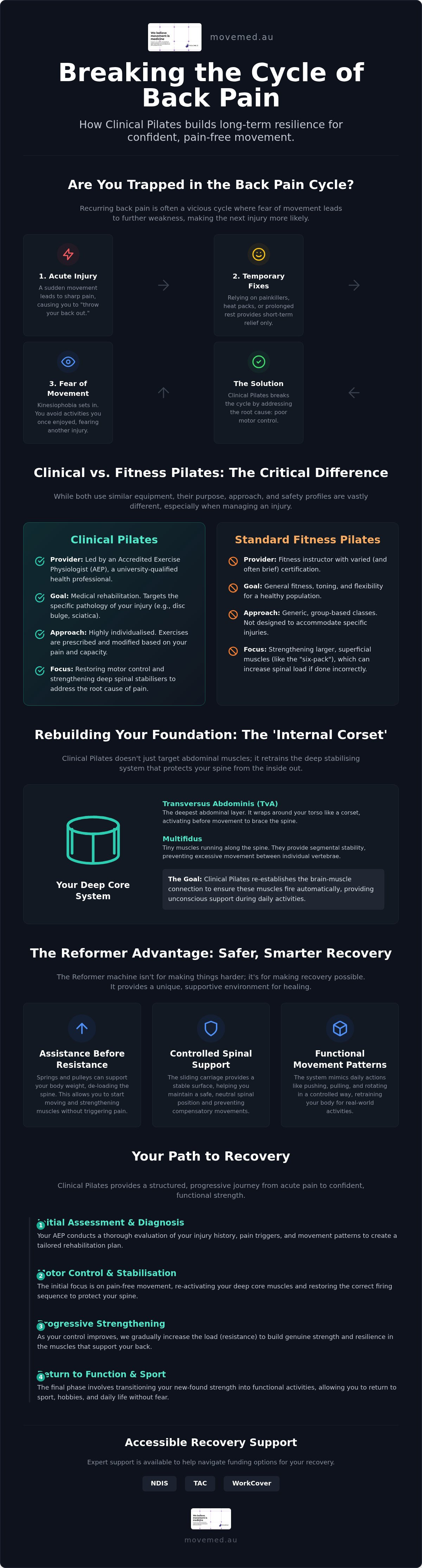
The Reformer is a specialised machine that uses a sliding carriage, springs, and pulleys to create a unique environment for recovery. For many of our clients, clinical pilates for back pain starts here because the Reformer offers a level of support that mat-based exercises simply cannot match. It allows for "assistance" to be provided before "resistance." This means the machine can support your body weight, making it easier to move without triggering a pain response.
- Precision Loading: We can adjust spring tension in tiny increments to match your exact strength.
- Spinal Support: The sliding carriage provides a stable surface that helps you maintain a safe spinal position.
- Functional Gains: The pulley system mimics daily movements, like reaching or lifting, but in a controlled and safe way.
Using clinical pilates for back pain on a Reformer is often safer for acute cases. It allows us to de-load the spine (reduce the pressure on your vertebrae) while still strengthening the deep stabilisers that protect you during daily activities. It's about moving smarter, not just harder.
How Clinical Pilates Repairs the "Underlying Causes" of Back Pain
Many people are told they have a "weak core" and that's why their back hurts. However, the reality is often more complex. It isn't just about the raw strength of your abdominal muscles; it is about motor control (the timing and coordination of how your muscles fire). When you have chronic pain, your brain often forgets how to engage the right muscles at the right moment. Clinical pilates for back pain works to recalibrate this timing, ensuring your spine is supported before you even begin to move.
A healthy spine requires a delicate balance between stabilisation and mobilisation. If you are too "stiff" because you are bracing against anticipated pain, you lose the fluid movement required for daily life. Conversely, if your stabilisers aren't engaging, your larger "mover" muscles have to work overtime to protect your spine, leading to fatigue and strain. We focus on building a resilient back that can handle the "load" of your daily life, whether that is lifting a toddler or sitting at a desk for eight hours. If you're ready to break the cycle of fear and move with confidence, our team can help you start your recovery journey today.
Targeting the Deep Stabilisers: Multifidus and Transversus Abdominis
Think of your deep stabilisers as an "internal corset." The multifidus (tiny muscles along your spine) and the transversus abdominis (the deepest layer of your abdominals) should ideally activate just before you move. Standard sit-ups or crunches often miss these muscles entirely, instead targeting the superficial "six-pack" muscles. If these superficial muscles pull without the support of the internal corset, they can actually increase the pressure on your spinal discs. Clinical pilates for back pain re-educates these deep layers to fire correctly, providing the internal support you need.
Movement Confidence and Reducing Kinesiophobia
Kinesiophobia is a clinical term for the fear of movement. When you've experienced a severe back flare-up, your nervous system becomes highly sensitive, often getting stuck in a "pain loop." Your brain perceives movement as a threat, which causes you to move tentatively or avoid activity altogether. This psychological state can be just as debilitating as the physical injury itself.
Through a process called graded exposure, we use the Reformer to help your brain feel "safe" again. By performing movements in a supported environment without a pain flare-up, you begin to break that psychological barrier. This builds trust in your body. It's a powerful shift when you realise you can move, stretch, and strengthen without the "payback" of a flare-up the next day.
Clinical vs. Fitness Pilates: Why the Distinction Matters
"I can just go to the local gym for a Pilates class, right?" It's a question we hear often. While a general fitness class is great for healthy individuals, it can be a risky environment if you're managing a complex injury like a disc bulge or sciatica. In a fitness setting, the goal is often a high-intensity workout. In contrast, clinical pilates for back pain is about precision. We focus on the "dosage" of exercise; the idea that three repetitions of the right move performed with perfect spinal alignment beat thirty repetitions of the wrong one every time. Quality of movement is what builds resilience, not just the quantity of sweat.
When you join a large group class, you're often subject to "group-think" programming. The instructor provides a general routine that everyone follows, regardless of their individual injury history. If you have a specific spinal condition, certain movements that are "good" for the general public might be exactly what triggers your next flare-up. This is why the distinction between clinical and fitness settings is so critical for your recovery.
Personalised Assessment vs. Group Programming
Every journey at MoveMed begins with a comprehensive initial assessment. We sit with you to discuss your medical history, analyse your posture, and conduct a detailed movement screen to see how your body handles load. This allows your Exercise Physiologist to create a unique roadmap tailored specifically to your back condition. Contrast this with a twenty-person gym class where the instructor simply cannot watch your form closely enough to ensure you aren't accidentally aggravating your injury. We don't believe in one-size-fits-all; we believe in what works for you.
Safety and Injury Prevention
Safety is our primary focus. During your session, we are constantly monitoring for "red flags," which are clinical indicators that a movement might be causing harm rather than helping. If you're doing clinical pilates for back pain, you have an expert's eyes on you at all times. This is vital because improper form can increase shear force (a sliding pressure) on your lumbar spine, potentially worsening a disc issue. Our Templestowe Lower clinic provides a calm, non-corporate environment where we can prioritise your safety and ensure every movement moves you closer to your goals.
Your Clinical Pilates Journey: What to Expect at MoveMed
Starting a new therapy can feel daunting when you have spent months or years protecting your back. You might worry about doing too much or triggering a flare-up. At MoveMed, we have designed a clear, patient journey that moves you from acute relief to long-term physical resilience. We don't just look at your back in isolation. Our holistic approach often integrates clinical pilates for back pain with other services like Hydrotherapy or broader Exercise Physiology consultations, ensuring every aspect of your movement is supported. This collaborative method means your recovery isn't just a series of exercises; it's a comprehensive plan tailored to your lifestyle.
Phase 1: The Initial Clinical Assessment
Your journey begins with a 1-on-1 session where we focus on three key areas to ensure your program is safe and effective:
- Discussing your pain history and lifestyle goals: We want to know exactly what you've been missing out on, whether that is playing with the grandkids, returning to the local footy club, or being able to sit through a movie without discomfort.
- Physical screening: We identify "compensatory" movement patterns. These are the subtle ways your body has learned to move to avoid pain, which often place extra stress on other joints and muscles.
- Setting a baseline: We establish where your strength and mobility sit today so we can measure your progress accurately and celebrate every small win.
Phase 2: Graded Loading and Progression
As your pain decreases and your confidence grows, your sessions evolve. We move from "supported" Reformer exercises, where the machine helps carry your weight, to more "functional" standing moves that mimic real-life tasks. This transition is vital for building a back that doesn't just feel good in the clinic but stays strong at home. We focus on graded loading, which is the process of slowly increasing the difficulty of your movements as your body becomes more capable. The ultimate goal is independence; we want to give you the tools and the confidence to manage your own health for the long term.
To see a meaningful change in chronic back pain, most clients find that attending one to two sessions per week provides the best results. This rhythm allows your nervous system to adapt to new movement patterns without being overwhelmed. It provides enough consistency to build muscle memory while giving your body time to recover between sessions. If you are ready to move beyond just managing symptoms and start building lasting strength, book your initial assessment with our Templestowe Lower team today.
Accessing Clinical Pilates in Templestowe: Funding and Next Steps
Residents in Templestowe Lower, Doncaster, and Bulleen often find that the most exhausting part of a back injury isn't the physical ache, but the administrative burden of seeking help. We believe that your energy should be spent on recovery, not on decoding insurance forms or NDIS plans. As your local community ally, MoveMed provides a calm, non-corporate space where we handle the complicated paperwork so you don't have to. We are more than just a clinic; we are your partners in reclaiming the movements that matter most to you.
NDIS, TAC, and WorkCover: Is Your Therapy Covered?
Understanding the maze of Australian funding schemes can feel overwhelming, but clinical pilates for back pain is often accessible through several pathways. We have extensive experience working within these systems to ensure you receive the high-quality care you deserve without the financial stress.
- NDIS participants: If you have a permanent disability, you can use your "Capacity Building" budget. Specifically, the "Improved Daily Living" category is designed to help you build the functional strength required for daily tasks.
- TAC and WorkCover: If your back pain is the result of a transport accident or a workplace injury, these schemes often fund Exercise Physiology-led sessions. We manage the billing directly with these providers to keep your journey as low-friction as possible.
- DVA (Department of Veterans’ Affairs): We are proud to support our veterans. Eligible DVA cardholders can access funded therapy to manage chronic musculoskeletal conditions and improve their long-term resilience.
How to Get Started at MoveMed Templestowe Lower
Taking the first step toward a pain-free life shouldn't be difficult. Whether you want to return to the golf course or simply pick up your groceries without fear, we have made the booking process straightforward and welcoming. You can book your initial assessment through our online portal or by calling our friendly team directly. While private health insurance clients don't require a GP referral to start clinical pilates for back pain, having one can be helpful if you are navigating a funded scheme or have a complex medical history.
Our clinic is conveniently located for those in the Manningham area, offering a quiet environment that focuses on your individual progress. We invite you to reclaim your move today. Let us sit with you, explain the process clearly, and start building the physical resilience you need for a more active, confident future.
Take the Next Step Toward a Stronger, Pain-Free Future
Recovering from chronic back pain isn't just about managing symptoms; it's about investing in your long-term physical resilience. By choosing clinical pilates for back pain led by Accredited Exercise Physiologists, you're moving beyond the "quick fix" and focusing on the underlying motor control and spinal stability required for daily life. Whether you are returning to sport or simply want to pick up your grandkids without hesitation, the right movement strategy can transform your confidence.
At MoveMed, we are proud to be a trusted community ally for residents in Templestowe, Doncaster, and the wider Manningham area. As a registered provider for NDIS, TAC, WorkCover, and DVA, we handle the administrative complexities so you can focus entirely on your journey. You don't have to navigate this path alone. Our team is here to guide you through a personalised program that prioritises your safety and your goals.
Ready to reclaim your independence? Book your initial Clinical Pilates assessment at MoveMed Templestowe Lower today and start building a back that can handle whatever life throws your way. We look forward to partnering with you on your road to recovery.
Frequently Asked Questions
Do I need a referral from my GP to start Clinical Pilates?
You don't need a GP referral if you're attending as a private client. You can simply book an assessment and start your journey. However, if you're accessing clinical pilates for back pain through a funded scheme like WorkCover, TAC, or DVA, a referral from your doctor is usually required to process the claim. We can help you navigate the specific requirements for your funding path during your first visit.
Is Clinical Pilates better than regular Physiotherapy for back pain?
It isn't necessarily better; it's a different approach. While traditional physiotherapy often uses manual therapy (hands-on treatment) for short-term relief, clinical pilates focuses on exercise physiology to build long-term resilience. We aim to treat the underlying cause of your pain by improving how your body moves and handles load. Many clients find that this movement-based approach provides a comprehensive path to recovery, especially when transitioning from acute pain to functional strength.
Can I do Clinical Pilates if I have a diagnosed disc bulge or sciatica?
Yes, you can safely participate. In fact, clinical reformer pilates is specifically designed to manage conditions like disc bulges and sciatica. Because our sessions are led by Accredited Exercise Physiologists, we can modify every movement to de-load your spine and avoid aggravating your nerves. We use the Reformer's spring tension to provide assistance, allowing you to strengthen your deep stabilisers without the high-impact stress found in general fitness classes.
How many sessions of Clinical Pilates will I need before my back feels better?
Every back is unique, but most clients begin to feel a positive difference after four to six weeks of consistent practice. We usually recommend attending one or two sessions per week to allow your nervous system and muscles time to adapt to new movement patterns. While initial relief can happen quickly, the goal is building lasting physical resilience, which requires a steady commitment to the graded loading process we discussed earlier.
What should I wear to my first Clinical Reformer Pilates session?
Wear comfortable, stretchy clothing that allows you to move freely, such as leggings or trackpants and a t-shirt. It's best to avoid zippers or buttons that might catch on the Reformer equipment. For hygiene and safety, we require all participants to wear socks during their session. Many clients prefer grip socks (socks with rubber dots on the sole) as they provide extra stability on the carriage, but standard socks are perfectly fine for your first visit.
Is Clinical Pilates covered by private health insurance in Australia?
Yes, most Australian private health insurers provide rebates for sessions led by Accredited Exercise Physiologists. You'll generally need to have "Extras" cover that includes Exercise Physiology. Since we use clinical assessment and individualised programming, our services meet the requirements for health fund claims. We recommend checking with your specific provider to confirm your level of cover and the rebate amount you can expect for your consultations.
I haven’t exercised in years—am I too "unfit" for Clinical Pilates?
You are never too unfit to start. One of the primary benefits of clinical pilates for back pain is that it meets you exactly where you are today. During your initial assessment, we establish your current baseline and build your program from there. The Reformer machine is incredibly versatile; it can provide significant assistance to make movements easier, ensuring you feel successful and safe from your very first session regardless of your fitness history.
How is Clinical Pilates different from the Reformer classes at my local gym?
The main difference lies in the clinical supervision and individualisation. Gym-based classes are usually group-fitness sessions where everyone follows the same routine. Clinical sessions are led by university-qualified Exercise Physiologists who use your medical history to prescribe specific movements for your injury. We focus on motor control and precision rather than just a high-intensity workout. This ensures your exercises are helping your recovery rather than accidentally increasing the shear force on your spine.


