

Where your knee hurts can offer a clue, but it doesn’t necessarily explain what’s causing knee pain. The front, side or back of the knee may feel sore for different reasons, and pain that begins after a particular movement still needs to be considered alongside your other symptoms.
You may be concerned that the pain is due to an injury, overuse or a health condition, and unsure whether you need medical help. The right next step depends on how your symptoms started, how they’re affecting you and what an assessment finds.
This article explains common causes of knee pain, why pain location alone doesn’t tell the whole story, and which symptoms need prompt medical attention. You’ll also learn what to note before an assessment and how to discuss practical next steps, including whether an individual exercise plan may be appropriate. Imaging isn’t always needed to begin care, and a health professional can help you understand what makes sense for your situation.
Key Takeaways
- Knee pain is a symptom, not a diagnosis; different causes can produce similar discomfort.
- What you were doing when the pain began can help a health professional assess what may be causing knee pain.
- Pain at the front, side or back of your knee offers useful clues, but location alone can’t identify the cause.
- Seek prompt medical assessment if you can’t bear weight or have severe pain after an injury.
- If knee pain persists, worsens or limits daily activities, an assessment can help guide appropriate next steps.
What could be causing knee pain? Start with the basics
Knee pain can be unsettling, especially when you’re unsure whether it started with an injury or appeared without a clear reason. Several different issues can produce similar symptoms. Pain is a signal, not a diagnosis, and it doesn’t automatically mean that you’ve damaged a particular part of your knee. To understand what may be causing knee pain, consider the whole picture rather than focusing only on the sore spot.
Your knee helps your leg bend, straighten and support your body as you move. The joint includes the kneecap, thigh bone and shin bone, with cartilage helping the bone surfaces move smoothly and cushioning them. Muscles, tendons and ligaments also contribute to movement and support. Pain may involve one or more of these structures, or relate to factors beyond a single part of the joint.
How the knee’s structures work together
The kneecap sits at the front of the joint and moves as you bend and straighten your leg. The thigh bone meets the shin bone, while cartilage helps cushion the joint surfaces. Ligaments connect bones and help support the joint. Tendons attach muscles to bones, allowing muscle force to move the leg.
These structures work together, so the location of pain alone can’t reliably identify which one is involved. This Knee pain overview describes the broad range of possible explanations, but general information cannot determine the cause of your symptoms.
Why the same symptom can have different causes
Broadly, knee pain may follow an injury, develop with repeated loading or be linked to a health condition. A twist, impact or sudden increase in activity can provide useful clues, but pain can also develop gradually or without one obvious event. These patterns help guide the questions to ask; they don’t prove a diagnosis.
An assessment considers more than the painful area. When did the pain start? What activities affect it? Have you noticed swelling, stiffness or changes in how you move? Your health history and any other symptoms also matter. Together, these details help a health professional decide what to examine and whether further assessment is needed.
An examination may be needed to identify the likely cause because similar knee symptoms can arise from different structures, activity patterns or health conditions.
This guide can help you understand common possibilities and prepare questions, but it can’t diagnose your individual knee pain. If symptoms are concerning, persistent or affecting everyday activities, seek advice from a suitable health professional rather than relying on pain location alone.
Common causes of knee pain: injury, overuse and health conditions
How your pain began can be a useful clue. A sudden twist or impact gives a different history from discomfort that builds during repeated activity, but neither pattern confirms a cause. Different issues can produce similar knee symptoms, so the way your pain feels cannot diagnose the problem on its own.
Injuries, repeated loading and health conditions are broad categories, not a ranking of what’s most likely for you. A health professional can use your symptoms, activity and medical history to decide what needs closer assessment. Mayo Clinic’s guide to Common causes of knee pain also outlines how injuries and health conditions may be involved.
Knee pain after an injury or change in activity
Did your pain start during a turn, fall, collision or sudden increase in exercise? That detail may help guide an assessment. A sprain, meaning an overstretched or injured ligament, another ligament injury or a meniscus injury involving the cartilage between the thigh and shin bones may be considered. Symptoms alone can’t confirm any of them.
Note what you were doing, when the pain began and whether you noticed swelling, a sense of giving way or difficulty moving the knee. These details help a clinician build a clearer picture, but they don’t point to one certain injury.
Recurring pain, overuse and musculoskeletal conditions
Pain can also develop gradually, particularly after repeated activity or a change in how much you’re doing. Running, kneeling or adding more activity may contribute to discomfort during or after movement. The timing is useful information, but it doesn’t establish that activity is the only cause.
Osteoarthritis is one possible health related cause, but knee pain doesn’t automatically mean you have it, and it isn’t an inevitable part of getting older. Other musculoskeletal conditions, which affect muscles, bones, joints, tendons or ligaments, may also be considered. Pain can arise without one memorable injury. If it persists or affects your usual activities, seek a suitable assessment rather than trying to identify a condition from symptoms alone.
After any necessary medical review, an exercise plan may be one support option, depending on your needs and capacity. MoveMed’s Exercise Physiology Consultations are delivered by Accredited Exercise Physiologists, who can help guide suitable clinical exercise as part of an individual plan.
Where your knee hurts and when it starts: useful clues, not a diagnosis
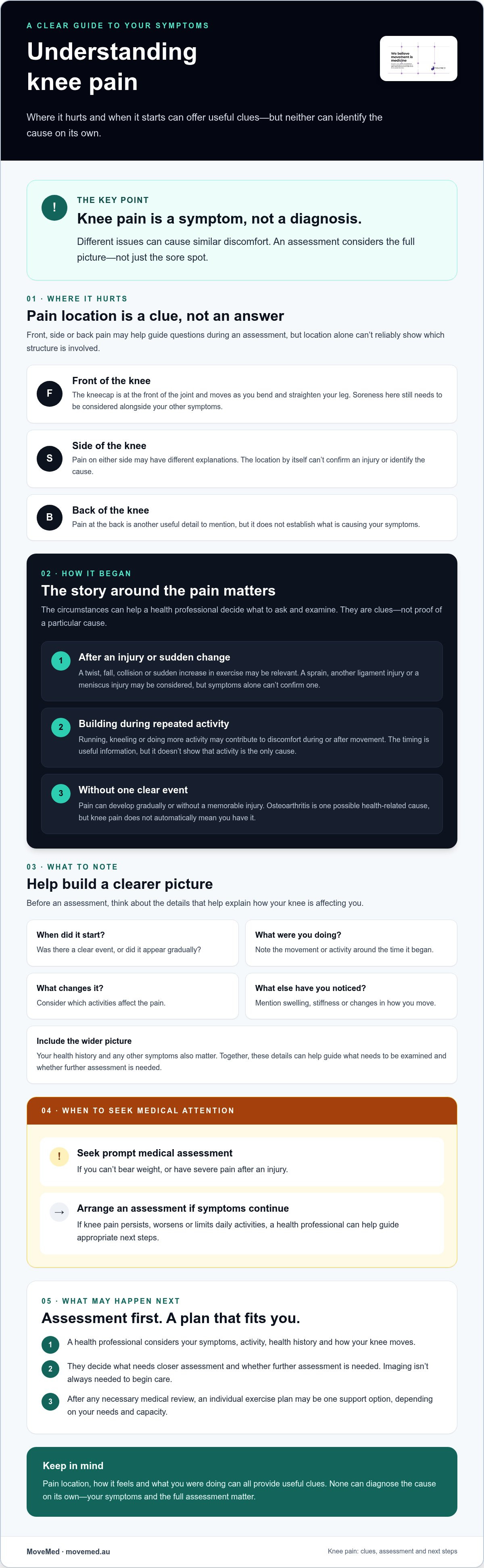
Noticing where the pain is and what brings it on can help you describe it clearly. But pain at the front, side or back of your knee doesn’t point to one certain condition. Symptoms overlap, and the same area can hurt for different reasons. Use location as a clue to record, not a way to diagnose yourself.
What front, side or back knee pain may suggest
Pain at the front may be associated with irritation around the kneecap or nearby tendons. Pain at the side can occur with different joint or soft tissue problems, particularly after a twist or impact. Discomfort behind the knee may also have several explanations. For general background, see this overview of knee pain causes. These are possibilities, not conclusions.
| Location or pattern | Possible explanations | What to record |
|---|---|---|
| Front of the knee | Issues around the kneecap or nearby tendons; causes vary. | Whether it starts with bending, stairs or another activity. |
| Side of the knee | Several joint or soft tissue causes; a twist may be relevant. | Which side hurts and whether pain followed a specific movement. |
| Back of the knee | Different joint or soft tissue causes may contribute. | When discomfort appears and whether movement feels restricted. |
| Pain during or after activity | Repeated loading or another cause may be involved. | What you were doing, when pain began and how it changed afterwards. |
If discomfort is behind your knee, you can read this related hydrotherapy guidance for knee pain. It provides general information, not an assessment of what’s causing your symptoms.
What timing and triggers can add to the picture
Think about whether pain began suddenly, developed gradually or returns during a particular activity. Note any stiffness, swelling, warmth, instability or changes in how you walk, bend or straighten your leg. Record what eases or worsens the discomfort and whether it affects everyday tasks. These details can help a clinician assess the pattern, but they can’t confirm the cause by themselves.
Knee pain doesn’t always mean you must stop all movement indefinitely. Depending on your symptoms, it may be sensible to adapt the activity, reduce what aggravates the pain and seek individual guidance. Don’t push through pain that’s worsening or changing how you move. A health professional can help you decide what activity is appropriate while you work out what may be causing knee pain.
When knee pain needs medical attention and how it may be assessed
Knee pain can often be assessed in a planned appointment, but some symptoms call for prompt medical advice. Don’t wait to see whether things settle if you’re unable to put weight on your leg or the pain is severe after an injury.
Symptoms that should not be ignored
Seek prompt medical assessment if you have:
- Severe pain after an injury, marked swelling, or a knee that feels unstable or gives way.
- Difficulty moving the knee or being unable to walk or bear weight on the leg.
- A hot, red, swollen knee with a fever.
Contact a doctor or an urgent health service for advice about concerning symptoms. If you believe you’re experiencing a life threatening emergency, call 000 or go to an emergency department. If you’re unsure where to seek help in Australia, Healthdirect can provide health advice and help you understand your options.
Knee pain warrants prompt medical assessment if you can’t bear weight, have severe pain after an injury, or notice significant swelling, marked instability or a hot, red knee with fever. Trust your concern if symptoms are rapidly worsening or you feel very unwell.
What to record before an assessment
A few clear notes can help you explain what’s changed without trying to diagnose yourself. Record:
- When the pain began and whether it followed an injury or other event.
- Which activities worsen or ease it, and whether the pain is changing.
- Any swelling, warmth, stiffness or feeling that the knee may give way.
- How symptoms affect walking, sleep and everyday tasks.
A clinician may ask about your health and symptoms, then assess how your knee moves and how it responds to examination. Further investigations, such as imaging, depend on your individual presentation; they aren’t automatically needed for every episode of knee pain. The clinician can explain what they’re considering and whether another step is appropriate.
If urgent symptoms have been assessed and you’re looking for guidance on suitable clinical exercise, you can discuss an Exercise Physiology Consultation with MoveMed. Accredited Exercise Physiologists can help shape an exercise plan around your assessment, goals and capacity. This is a possible support option, not a substitute for medical assessment when warning signs are present.
Next steps for ongoing knee pain: build a plan around your goals
If your knee pain persists, worsens or starts limiting walking, work, sleep or other everyday activities, arrange a medical review. This is especially sensible after an injury or if you’re unsure what’s safe to do. An assessment can help clarify what may be contributing to your symptoms and whether further care is appropriate. You don’t need to work out the cause on your own.
Once urgent concerns have been addressed, build any next steps around your needs. The right activity depends on your assessment, goals, symptoms and current capacity. You may want to manage stairs more comfortably, return to a valued activity or maintain independence in daily life. Share these priorities with your health professional so any plan is relevant to you.
How supervised exercise may fit into knee care
Structured exercise may be one option to discuss after appropriate clinical assessment. Accredited Exercise Physiologists are university qualified allied health professionals who design, deliver and evaluate exercise interventions. They can consider your presentation and goals when developing a suitable programme, rather than assuming the same movements are right for everyone.
For people with hip or knee osteoarthritis, the GLA:D program guide explains this evidence based exercise and education programme. Whether it is appropriate for you depends on your situation and should be discussed with a suitable health professional. Exercise support is not a substitute for assessment or a guaranteed cure.
Finding support in Melbourne’s east
If you live in Templestowe Lower, Templestowe, Doncaster, Doncaster East, Bulleen, Warrandyte, Lower Plenty, Balwyn North or Box Hill, MoveMed offers Exercise Physiology Consultations, hydrotherapy and Clinical Reformer Pilates. Its Accredited Exercise Physiologists can help you consider whether a structured exercise option may suit your goals after assessment. These services are possible supports, not a diagnosis of what’s causing knee pain.
Before a conversation with a health professional, note which activities matter to you, what your symptoms make difficult and any questions you want answered. This can help focus discussion on practical next steps and how progress will be reviewed. To learn more, explore MoveMed’s services and discuss which options may be suitable for your needs.
Take a considered next step for your knee
Working out what’s causing knee pain takes more than noticing where it hurts. How symptoms began, what affects them and how they limit your movement all offer useful clues, but they can’t confirm a diagnosis on their own. If pain persists, worsens or affects daily activities, seek an assessment. Get prompt medical advice for severe pain after an injury, difficulty bearing weight, significant swelling or a hot, red knee with fever.
Your next steps should reflect your assessment, goals and capacity. For some people, structured exercise may be part of an ongoing plan. MoveMed’s Accredited Exercise Physiologists design and evaluate exercise interventions, and the GLA:D program offers exercise and education for people with hip or knee osteoarthritis. These options don’t replace medical assessment when it’s needed.
If you’re ready to explore suitable support, explore MoveMed’s services and discuss your next step. With clear guidance, you can make informed choices and work towards movement that supports your everyday goals.
Frequently Asked Questions
What are the most common causes of knee pain?
Common causes include injuries such as sprains or meniscus injuries, pain associated with repeated loading, and health conditions such as osteoarthritis. The possible cause depends on how your symptoms began, what activities affect them and your health history. Similar symptoms can have different explanations, so a list can’t diagnose your knee. A health professional can assess your symptoms and movement, then advise whether further investigation is appropriate.
Can knee pain happen without an injury?
Yes, knee pain can develop without a clear injury. It may build gradually with repeated activity or be associated with a health condition. Sometimes there’s no single event you can point to. Note when the pain started, which activities change it and whether you have swelling or stiffness. If symptoms persist, worsen or affect daily activities, arrange an assessment rather than trying to identify what’s causing knee pain by yourself.
Is knee pain always a sign of osteoarthritis?
No, knee pain doesn’t always mean you have osteoarthritis. An injury, repeated loading or another health condition may also contribute, and symptoms alone can’t confirm the cause. Osteoarthritis isn’t inevitable with age, either. If you’re concerned, a health professional can consider your symptoms, health history and knee movement to guide an assessment. You don’t need to assume a diagnosis based on your age or the location of the pain.
What does pain in the front, side or back of the knee mean?
Pain location can offer clues, but it can’t identify one specific condition. Pain at the front may have different explanations from pain at the side or behind the knee, and symptom patterns can overlap. Note where it hurts, when it starts and what you were doing. Also record stiffness, swelling or changes in movement. A clinician can consider these details alongside an examination to help decide what may be contributing.
When should I see a doctor about knee pain?
Seek prompt medical advice if you have severe pain after an injury, significant swelling, an unstable feeling knee, or difficulty moving or bearing weight on your leg. A hot, red, swollen knee with a fever also needs prompt clinical advice. For a life threatening emergency in Australia, call 000 or go to an emergency department. Arrange a medical review for pain that persists, worsens or limits your usual activities.
Can I keep exercising if knee movement causes pain?
It depends on your symptoms and what’s causing them, so don’t push through pain that worsens or changes how you move. You may be able to adapt an activity, but the right approach varies from person to person. If you’ve had an injury, have concerning symptoms or are unsure what’s safe, seek medical advice. After assessment, a health professional can help you consider suitable activity and whether guided exercise may fit your needs.
What happens if knee pain does not improve?
If knee pain doesn’t improve, is getting worse or continues to affect walking, sleep or everyday tasks, book a medical review. A clinician can reassess your symptoms and movement, discuss possible next steps and decide whether investigations are needed. If appropriate after assessment, structured exercise may be one support option. MoveMed offers exercise physiology in Templestowe Lower, Templestowe, Doncaster, Doncaster East, Bulleen, Warrandyte, Lower Plenty, Balwyn North and Box Hill.


