
What if pain behind your knee isn’t always coming from the knee joint itself? If bending, walking or standing is uncomfortable, it’s understandable to wonder whether your back knee problems are serious and whether rest or professional advice is the right next step. The pattern of your pain and any other symptoms can help guide that decision, but they can’t confirm a cause on their own.
This article explains common reasons for pain behind the knee, from muscle or tendon strain to issues involving the knee joint. You’ll learn which signs may need prompt medical attention and what you can do safely while deciding whether to seek an assessment.
We’ll also cover how a health professional can assess your symptoms and help you find suitable movement, rather than relying on guesswork or pushing through pain. Where appropriate, an Accredited Exercise Physiologist can guide a personalised exercise plan. The aim is to help you understand your options and take a measured next step.
Key Takeaways
- Pain behind the knee can have several possible causes. The location alone can’t tell you what’s responsible.
- Note when your back knee problems began and what affects them, so you can share useful details during an assessment.
- Changes in swelling or movement may help guide a discussion with a health professional, but symptom patterns aren’t a diagnosis.
- Adjust activities that aggravate your pain and seek suitable advice rather than assuming complete rest or exercise is right for you.
- After appropriate assessment, an Accredited Exercise Physiologist can help plan personalised movement. MoveMed supports local clients around Templestowe and nearby suburbs.
Back knee problems: what pain behind the knee can mean
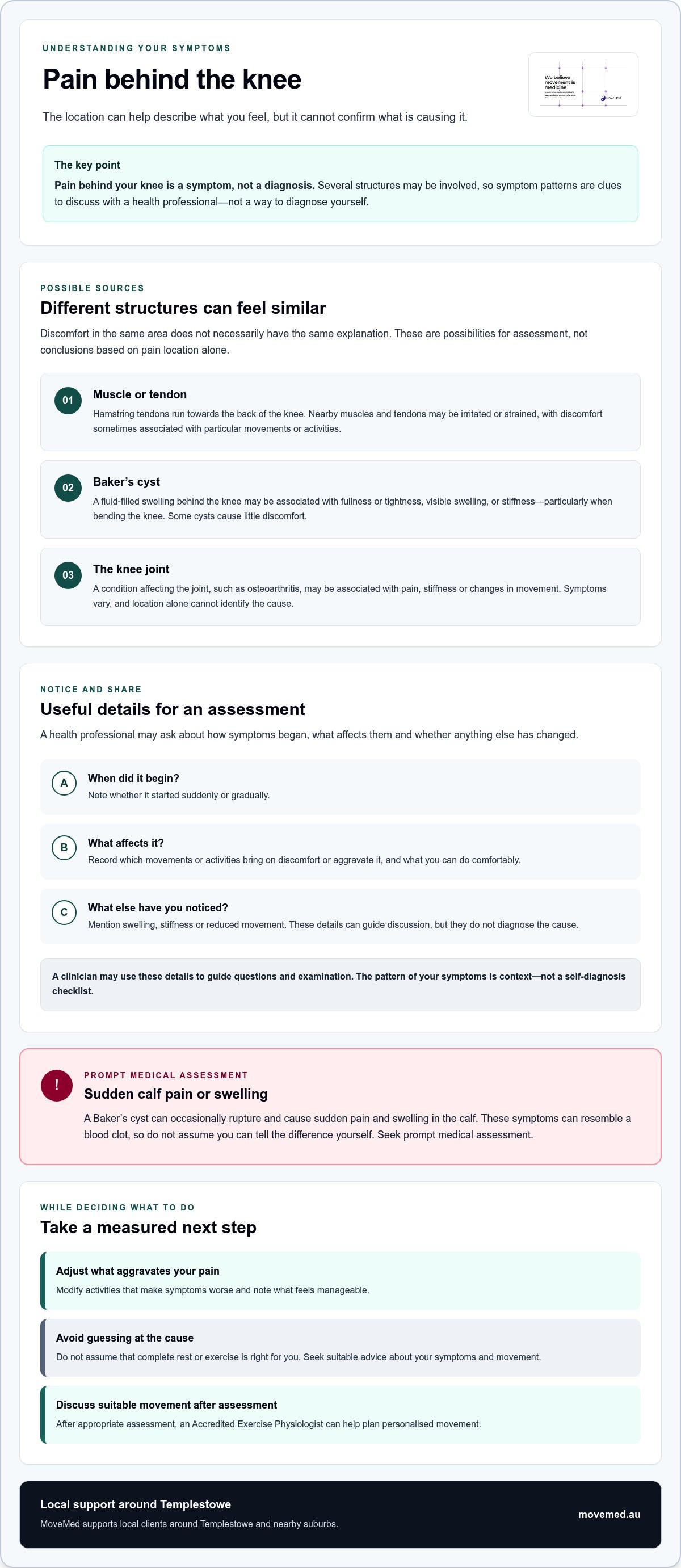
Pain behind your knee can make everyday movements, such as getting up from a chair or walking, feel uncertain. The location is useful to describe, but it doesn’t tell you exactly what’s happening or whether a particular condition is present.
Pain behind the knee is a symptom, not a diagnosis. Its cause needs to be considered alongside how the pain began, what affects it and whether you have other symptoms.
Where is the back of the knee?
The back of the knee is also called the popliteal region. In plain language, it’s the area at the rear of the joint. The shallow hollow there is known as the popliteal fossa. You may notice it when your knee is bent, although its shape and feel can vary from person to person.
Several body structures meet around this area, including muscles, tendons and ligaments. The knee joint and nearby tissues also affect how the region moves and bears load. That’s why pain can feel as though it comes from one small spot even when more than one structure may be relevant.
Why can the same symptom have different causes?
Discomfort at the back of the knee may relate to nearby soft tissues, such as a muscle or tendon, or to something within or around the knee joint. For example, a Baker’s cyst is a fluid-filled swelling that can develop behind the knee, while tendon irritation involves tissue that connects muscle to bone. These are possibilities to discuss, not conclusions you can draw from pain location alone. A general overview of common causes of knee pain also shows how different structures and injuries can contribute to symptoms.
Details about your experience help a clinician decide what to assess. They may ask whether symptoms started suddenly or gradually, whether a particular movement or activity brings them on, and whether you’ve noticed swelling, stiffness or reduced movement. These clues can guide further questions and examination, but they aren’t a self-diagnosis checklist.
If you’re dealing with back knee problems, note what you can do comfortably and what seems to aggravate the pain. Sharing those details during an assessment can help build a clearer picture and guide the next step.
Common causes of back knee problems and how symptoms may differ
Pain behind the knee can come from different structures, and similar symptoms don’t necessarily have the same explanation. Swelling, stiffness or discomfort during movement may occur with more than one condition. These details can help a clinician decide what to assess, but they can’t identify the cause on their own.
Could a Baker’s cyst cause pain behind the knee?
A Baker’s cyst is a fluid-filled swelling that forms behind the knee. It may cause a sense of fullness or tightness, visible swelling, or stiffness, particularly when bending the knee. Some cysts cause little discomfort, while others are more noticeable. A clinician can assess the area and consider whether a cyst or another knee issue may be involved. You can read more about a Baker's cyst behind the knee from Mayo Clinic.
Occasionally, a Baker’s cyst can rupture, causing sudden pain and swelling in the calf. These symptoms can resemble a blood clot, so don’t assume you can tell the difference yourself. Seek prompt medical assessment if you develop sudden calf pain or swelling.
Can tendons or the knee joint contribute?
Hamstring tendons run down towards the back of the knee, while the popliteus is a small muscle located behind the joint. Irritation or strain affecting nearby muscles or tendons may be associated with pain during particular movements or activities. But the activity that brings on pain isn’t enough to confirm a tendon problem.
Conditions affecting the knee joint can also be felt at the back of the knee. Osteoarthritis, for example, affects the joint and may be associated with pain, stiffness or changes in movement. Symptoms vary, and pain location alone can’t establish whether osteoarthritis or another joint condition is present.
Symptom patterns can guide an assessment, but they can’t confirm the cause. Note whether symptoms came on suddenly or gradually, what movements affect them, and whether you’ve noticed swelling or stiffness. These observations give a clinician useful context without turning your notes into a self-diagnosis.
If discomfort is limiting your movement, an Accredited Exercise Physiologist may be able to help plan suitable activity after appropriate assessment. You can learn about MoveMed exercise physiology consultations as one local support option.
How to compare back knee symptoms and recognise warning signs
Noticing how your symptoms change can help you explain what’s happening and decide how soon to seek advice. The patterns below are prompts for a conversation with a health professional, not diagnostic tests. Similar symptoms can have different causes, so don’t use the table to rule a condition in or out.
| What to notice | Details to share |
|---|---|
| Onset | Did the pain start suddenly or build gradually? Did it follow a fall, twist or other injury? |
| Activity triggers | Which movements or activities make it worse, if any? What can you still do comfortably? |
| Swelling | Is there swelling behind the knee, around the joint or in the calf? When did you first notice it? |
| Movement changes | Is the knee stiffer, harder to bend or straighten, or more difficult to use than usual? |
What details should you notice before seeking advice?
Keep a brief note of when symptoms began, whether an injury preceded them, and how they change over time. Include swelling, stiffness and movements that feel limited, as well as any new symptoms. You don’t need to test the knee or push into pain to gather information. These observations can support an assessment, but they can’t establish a diagnosis.
When should back knee problems be checked promptly?
Seek prompt medical advice after a significant injury, or if pain is severe, swelling develops quickly, you can’t put weight on the leg, or you can’t move the knee normally. A hot, red or markedly swollen knee with fever also needs urgent medical review, as it may signal a problem requiring timely care.
New pain or swelling in one calf needs urgent assessment, particularly if it appears suddenly. A blood clot is one possible cause and can’t be ruled out at home. If calf symptoms occur with chest pain, sudden difficulty breathing, fainting or collapse, call 000 for an ambulance. Healthdirect provides Australian health advice, but emergency symptoms need emergency care rather than exercise guidance.
If you’re unsure how quickly to seek help, contact a health professional or call Healthdirect on 1800 022 222 for advice. If symptoms are severe or rapidly worsening, don’t wait for a routine appointment.
Managing Pain Behind the Knee Before Your Assessment
If pain behind your knee is affecting daily activities, it can be hard to know whether to rest, keep moving or seek advice. There isn’t one approach that suits every cause. Notice how symptoms behave, adjust activities that aggravate them and arrange suitable advice if the problem persists, worsens or limits your usual routine.
How can you stay active without pushing through pain?
Keep movement comfortable and adapt tasks that bring on pain. For example, you might shorten a walk or temporarily avoid a position if it clearly aggravates your knee. Don’t force a painful range or follow an exercise plan designed for a different problem. Complete rest isn’t automatically the right answer either. The safest level and type of activity depend on your symptoms and, where needed, clinical assessment.
Choose movement in line with your symptoms and clinical guidance, not by pushing through worsening pain. Stop an activity if it sharply increases your symptoms, and seek advice before trying it again. If you have sudden severe pain, a significant injury, or warning signs such as those described in the previous section, seek urgent medical care rather than trying to exercise through them.
What information helps a clinician assess the problem?
A few clear notes can make it easier to explain your back knee problems during an appointment. Consider recording:
- When the discomfort began and whether it followed an injury.
- Any recent change in your usual activity, such as doing more walking or starting a new task.
- How symptoms have changed, including whether they’re improving, staying similar or worsening.
- Any swelling, stiffness, or changes in how far you can bend or straighten your knee.
- Relevant health conditions and activities you’re finding difficult.
You don’t need to work out what your notes mean. A health professional can use this history, along with an appropriate assessment, to consider what may be contributing and whether further assessment or referral is needed. Seek advice if symptoms aren’t settling, are getting worse or are interfering with everyday activities.
After appropriate assessment, an Accredited Exercise Physiologist can help plan personalised movement that takes your needs and symptoms into account. If you’re ready to discuss suitable exercise support, ask MoveMed about Exercise Physiology Consultations.
Getting support for back knee problems around Templestowe
If pain behind your knee is making everyday movement harder, the next step doesn’t have to be a one-size-fits-all exercise plan. After appropriate assessment, an Accredited Exercise Physiologist can help you consider movement that reflects your health, current capacity and goals. Their role is to plan suitable exercise support, not to diagnose the cause of your symptoms or replace medical care when that’s needed.
What can an Accredited Exercise Physiologist help you work towards?
MoveMed’s exercise physiology programs are personalised and evidence-based. Depending on your needs, a program may focus on building strength, maintaining or improving mobility, and helping you feel more confident with movement. Planning starts with your individual circumstances, including the activities that matter to you and the movements you can currently manage. Your plan can then be adjusted in line with your response and clinical guidance. There’s no guaranteed outcome or set recovery timeframe.
Could hydrotherapy or Clinical Reformer Pilates suit your plan?
Possibly, but neither option is right for everyone or every cause of pain behind the knee. An Accredited Exercise Physiologist can consider your symptoms, assessment findings and goals before discussing whether a clinician-guided option may fit your plan. Hydrotherapy involves movement in water; read MoveMed’s hydrotherapy guide for general information about water-based recovery. You can also explore the Clinical Reformer Pilates guide to learn about clinician-led movement. These resources provide background, not a recommendation for your particular symptoms.
MoveMed provides exercise physiology, hydrotherapy and Clinical Reformer Pilates for local clients in Templestowe Lower, Templestowe, Doncaster, Doncaster East, Bulleen, Warrandyte, Lower Plenty, Balwyn North and Box Hill. If you’re unsure whether exercise support is suitable, discuss your goals and whether an assessment is an appropriate next step. That can help you make an informed decision without assuming a particular treatment is needed.
Take a considered next step for your knee
Pain behind the knee can have different causes, so the location alone can’t tell you what’s going on. Notice how symptoms began, what affects them and whether swelling or movement changes develop. These details can help a health professional assess your situation, but they aren’t a substitute for an assessment. Seek prompt medical advice if symptoms are severe, follow a significant injury or come with urgent warning signs.
If back knee problems are limiting the activities you value, you don’t have to decide on an exercise plan alone. MoveMed’s Accredited Exercise Physiologists develop personalised exercise plans after appropriate assessment. Depending on your needs and goals, exercise physiology, hydrotherapy or Clinical Reformer Pilates may be considered as part of your support.
Talk with MoveMed about a suitable next step and whether an assessment or exercise support may fit your goals. A measured plan can help you move forward with greater confidence, one step at a time.
Frequently Asked Questions
Is pain behind the knee serious?
It can range from a temporary irritation to a problem that needs prompt medical attention. The pain’s location alone can’t show what’s causing it. Consider how it started, whether it’s worsening, and whether you have swelling or trouble moving or bearing weight. Seek medical advice if symptoms persist or limit everyday activities, and get urgent help for severe or rapidly worsening symptoms.
Can a Baker's cyst cause back knee problems?
Yes. A Baker’s cyst is a fluid-filled swelling behind the knee and may cause tightness, stiffness or a feeling of fullness. It doesn’t explain every case of pain or swelling, and it can’t be reliably identified by symptoms alone. A health professional can assess what you’re experiencing and advise whether further medical review is needed, particularly if swelling or pain changes suddenly.
Why does the back of my knee hurt when I bend it?
Pain during bending can have different explanations, including irritation in nearby muscles or tendons, a Baker’s cyst, or a problem involving the knee joint. Stiffness or swelling may also affect how bending feels. Note which movements are uncomfortable and whether symptoms began after an injury, but don’t use that pattern to diagnose yourself. An assessment can help determine an appropriate next step.
Can exercise help with pain behind the knee?
Suitable movement may form part of a plan, but the right activity depends on what’s causing your symptoms and how your knee responds. Avoid forcing painful movements or assuming that complete rest is necessary. If activity sharply worsens the pain, stop and seek advice. After appropriate assessment, an Accredited Exercise Physiologist can help plan personalised exercise that reflects your health, capacity and goals.
When should I seek medical help for pain behind my knee?
Seek prompt medical advice if pain follows a significant injury, becomes severe, swelling develops quickly, or you can’t bear weight or move the knee normally. Sudden calf pain or swelling also needs urgent assessment. If calf symptoms occur with chest pain, difficulty breathing, fainting or collapse, call 000 for an ambulance. For advice in Australia, you can also call Healthdirect on 1800 022 222.
What happens during an assessment for back knee problems?
A health professional will usually ask when the pain began, whether there was an injury, what affects it, and whether you’ve noticed swelling or changes in movement. They may discuss your health history and the activities you want to manage. An Accredited Exercise Physiologist can use relevant assessment information to plan suitable exercise support, but doesn’t replace a medical practitioner when medical review or referral is needed.


