
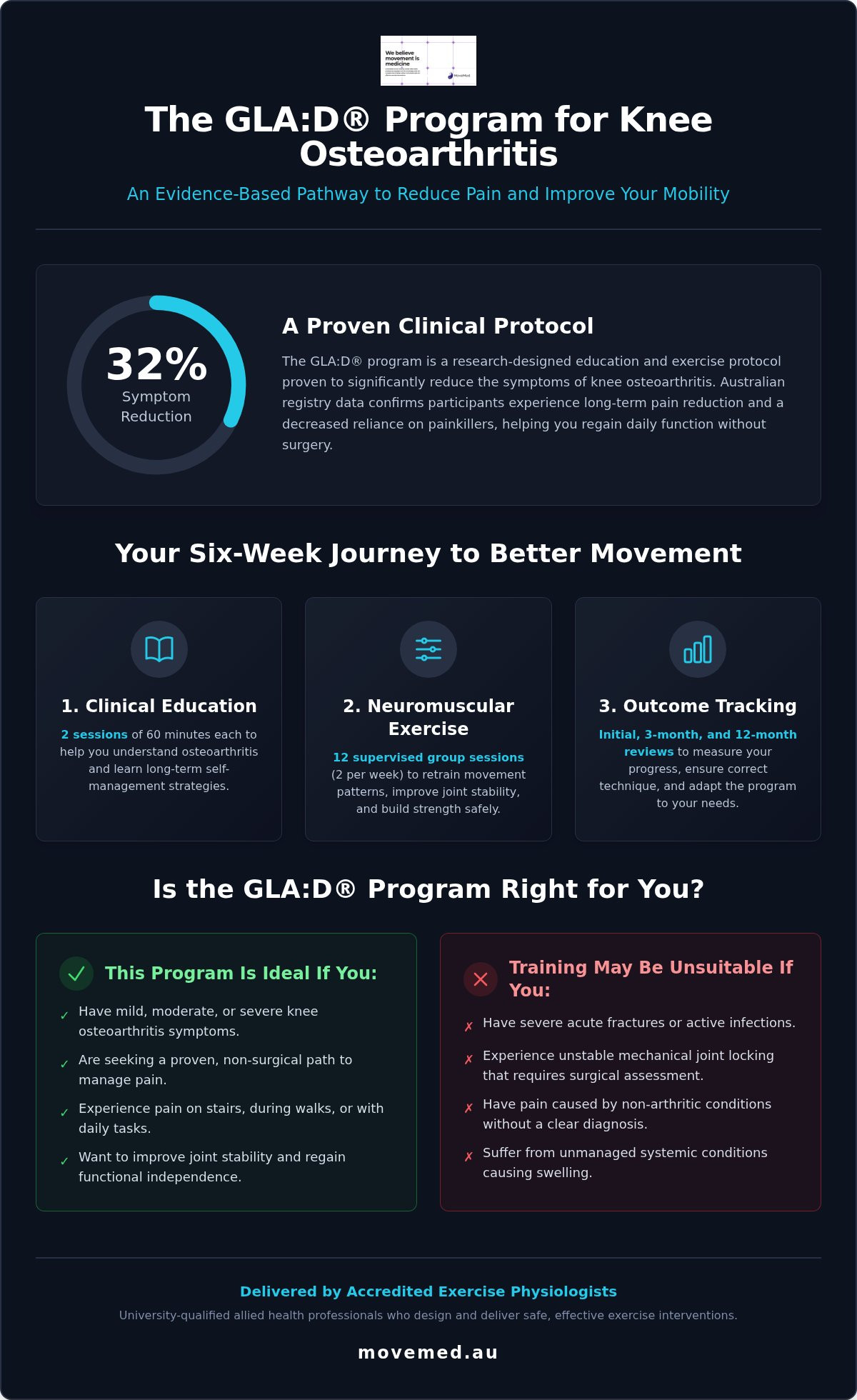
The GLA:D program for knee pain (knee osteoarthritis) is an evidence-based education and exercise protocol proven to reduce knee osteoarthritis symptoms by up to 32%. Designed by researchers, it combines structured group education with targeted neuromuscular control training. Individuals across Templestowe, Victoria can access these exercise sessions (exercise interventions) to improve joint stability (musculoskeletal alignment) and regain daily function.
Key Takeaways: The GLA:D program for knee pain is a six-week clinical protocol involving two education sessions and twelve supervised exercise classes to improve joint stability.
- Research shows participants experience up to a 32% reduction in knee osteoarthritis symptoms.
- Avoid this program if you have acute fractures, active infections, or mechanical joint locking.
- Best for individuals seeking a non-surgical pathway to manage mild to severe osteoarthritis symptoms.
- Australian GLA:D registry data confirms significant long-term pain reduction and decreased reliance on painkillers.
How the GLA:D program for knee pain matches your goals
The GLA:D program offers a structured pathway to manage knee pain based on your mobility goals and funding options. Your individual physical capacity determines the soundest entry point for long-term progress. Australian guidelines strongly support targeted exercise as a first-line intervention.
Typical situations we sort at assessment look like this:
- Mild discomfort: standard exercise sessions build strength without overloading the joint.
- Moderate pain on stairs or walks: prioritise joint stability so you regain confidence in daily tasks.
- Advanced joint wear: start under closer clinical supervision before you progress load.
Funding eligibility varies across private health funds, Medicare, and national support schemes. You can compare pathways in this eligibility overview; the route suits people who want structured clinical care. Severe joint degeneration often needs that tailored supervision before you advance.
Finding the right fit means balancing physical readiness, health fund rebates, and personal budget. Discuss your needs with a qualified clinician to confirm suitability, then book an assessment when you are ready to start.
What six weeks of structured sessions deliver
The GLA:D program combines two clinical education sessions with twelve supervised exercise sessions over a structured six-week timeframe.
| Program Phase | Components | Weekly Commitment |
|---|---|---|
| Education | 2 patient education sessions | 60 minutes per session |
| Neuromuscular Exercise | 12 group exercise sessions | 2 sessions per week (60 mins each) |
| Outcome Tracking | Initial, 3-month, and 12-month testing | Baseline and follow-up reviews |
This curriculum supports long-term self-management for knee pain. It targets core control and joint stability so you retrain safer movement patterns. Building dynamic stability redistributes daily load across the limb the way a fresh wheel alignment spreads wear across a set of car tyres.
Each session adapts to your current physical abilities, and group settings add steady mutual encouragement. For a deeper walkthrough of the knee pathway, read the detailed knee guide.
A clinician-led, evidence-based route is a reliable way to regain functional independence. Clinicians stay with you across the six weeks so technique and load stay appropriate. Ask the Templestowe team for program dates when you want to lock in a start.
Who sees meaningful mobility gains from training
When stairs provoke sharp discomfort, targeted training gives you a clear route toward sustained relief. Research shows structured exercise interventions reduce knee pain symptoms significantly across stages of joint degeneration.
Correcting movement patterns lowers stress on sensitive joint tissues during everyday walking and standing. Developing joint stability around the knee eases that stress even when wear is already advanced: the surrounding muscles act as shock absorbers, so the joint surface no longer takes the full force of every step.
People with mild, moderate, or severe symptoms often report clearer daily mobility once strength and control improve. Joining the GLA:D service page places you in that structured support. Active rehabilitation remains a proven non-surgical path forward. More on this: D Program for Hip &.
If surgery feels like your only remaining option, evidence-based training frequently delays or removes the need for invasive procedures by building lasting physical capacity. The clinical team guides you stage by stage so load progresses safely. Book an initial assessment when you want a clear read on whether this pathway fits.
When structured neuromuscular training is unsuitable
The GLA:D program is not suitable for severe acute fractures, active infections, or non-arthritic causes of knee pain.
Patients with unstable joint mechanical locking need prompt surgical assessment rather than progressive loading. Targeted neuromuscular training cannot restore structural integrity when an acute traumatic injury has already compromised basic joint stability.
Avoid starting targeted rehabilitation without a clear diagnosis. Progressive exercise interventions (exercise sessions) may aggravate secondary swelling if an unmanaged systemic condition is driving the discomfort.
This pathway is built for structural cartilage change. If your symptoms trace to hip joint degeneration instead, review the notes on hip-focused GLA:D.
An exercise physiologist team in Templestowe can review your symptoms and confirm whether structured neuromuscular training matches your health goals before you commit.
How funding shapes your out-of-pocket cost
Your total out-of-pocket investment for managing knee pain depends on healthcare rebates and funding pathways you already hold.
Structured exercise interventions tend to repay the fee when they sit inside a longer care plan, because avoiding surgery spares substantial medical cost over time. Proactive conditioning is cheaper than a later overhaul of the joint.
Funding options lower personal expenses in several ways. Under a Chronic Disease Management plan, Medicare rebates apply to a maximum of five allied health services in total per calendar year. Private health insurance often covers small group sessions led by an exercise physiologist or physiotherapist. NDIS participants can access fully funded pathways when physical goals align with an approved plan. Eligible veterans may receive full coverage through DVA arrangements.
Discuss referral options with your doctor so the plan matches both clinical need and budget. Hearing how other families organised ongoing care underlines the value of steady professional support.
Tip: Check if your private health fund covers Group Exercise Physiology under Item 502 or 561 to reduce your out-of-pocket expenses.
Among Google reviews for the clinic, one long-term client (5★) wrote:
"My son and I have been seeing Arthur and his team of Exercise Physiologists for years. We have been very impressed with their level of professionalism and skill. A special shout out to both Gilbert and Arthur."
That feedback points to how sustained clinical guidance helps families manage physical health efficiently over years, not only across a single six-week block.
Enrolment steps that get you training safely
Enrolling in a local program for knee pain starts with a clinical evaluation so treatment stays safe and well targeted.
Booking that assessment early lets the team shape group classes around your movement patterns before the first education session, which builds confidence for the weeks ahead.
- Initial assessment: Book a comprehensive evaluation with an exercise physiologist at MoveMed to discuss your goals and review medical history.
- Personalised planning: Your clinician outlines a structured pathway to improve joint stability and mobility.
- Education modules: Attend dedicated learning sessions that explain pain mechanics, self-management strategies, and exercise techniques.
- Group exercise sessions: Join practical group classes twice weekly to build physical strength under direct clinical supervision.
Each step supplies evidence-based guidance aimed at restoring functional independence. Contact the Templestowe team to arrange your first appointment when you are ready to begin.
Frequently asked questions
What does the program include?
The GLA:D program for knee pain provides structured education, tailored group exercise sessions, and physical testing. Clinical measurements track your individual progress.
How many education and exercise sessions are included?
You will complete two patient education sessions alongside twelve targeted exercise sessions. These supervised classes run twice weekly over six weeks.
What topics are covered in the education sessions?
Education sessions explore knee pain symptoms, evidence-based treatments, self-management strategies, and practical exercise benefits. You learn how to manage daily activities effectively at home or around Templestowe.
What type of exercises are performed?
You perform targeted neuromuscular movements designed to improve joint stability and overall leg strength. Certified clinicians guide each movement to ensure safe execution.
How effective is the program?
Data demonstrates significant long-term reductions in joint discomfort alongside improved physical function. According to Australian GLA:D registry outcomes, participants experience meaningful reductions in pain intensity and reduced reliance on painkillers.
Managing Your Next Steps
Targeted exercise sessions offer proven relief for knee pain in 2026, provided the pathway matches your diagnosis, stage of symptoms, and funding mix.
Accredited clinicians provide structured support so you build joint stability safely. Better functional mobility returns you to daily activities with clearer confidence, using progressive movement rather than guesswork.
If you want to move better, feel better, perform better, discuss your tailored plan with an Accredited Exercise Physiologist. Reach the MoveMed team via our contact page to begin your GLA:D program for knee pain.


