
Finding an accredited exercise physiologist in Port Melbourne requires understanding specific clinic services, third-party coverage options, and typical Melbourne market fees. Local initial consultations vary in price depending on your chosen clinic, length of care, and individual health requirements. You can speak directly with local clinics to request a personalized quote for your specific treatment plan. The decisions that matter most are which care pathway fits your stage of recovery, how exercise physiology differs from hands-on physiotherapy, whether third-party funding applies, and what local fees look like before you book.
Match your Port Melbourne goals to a clear care pathway
Choosing an exercise care plan depends directly on your current mobility goals and health history. Clients who pick a targeted pathway often recover with less long-term joint strain than those who default to generic gym routines. Customised programs help you move with clarity.
Typical situations and a concrete next step from the same clinical toolkit:
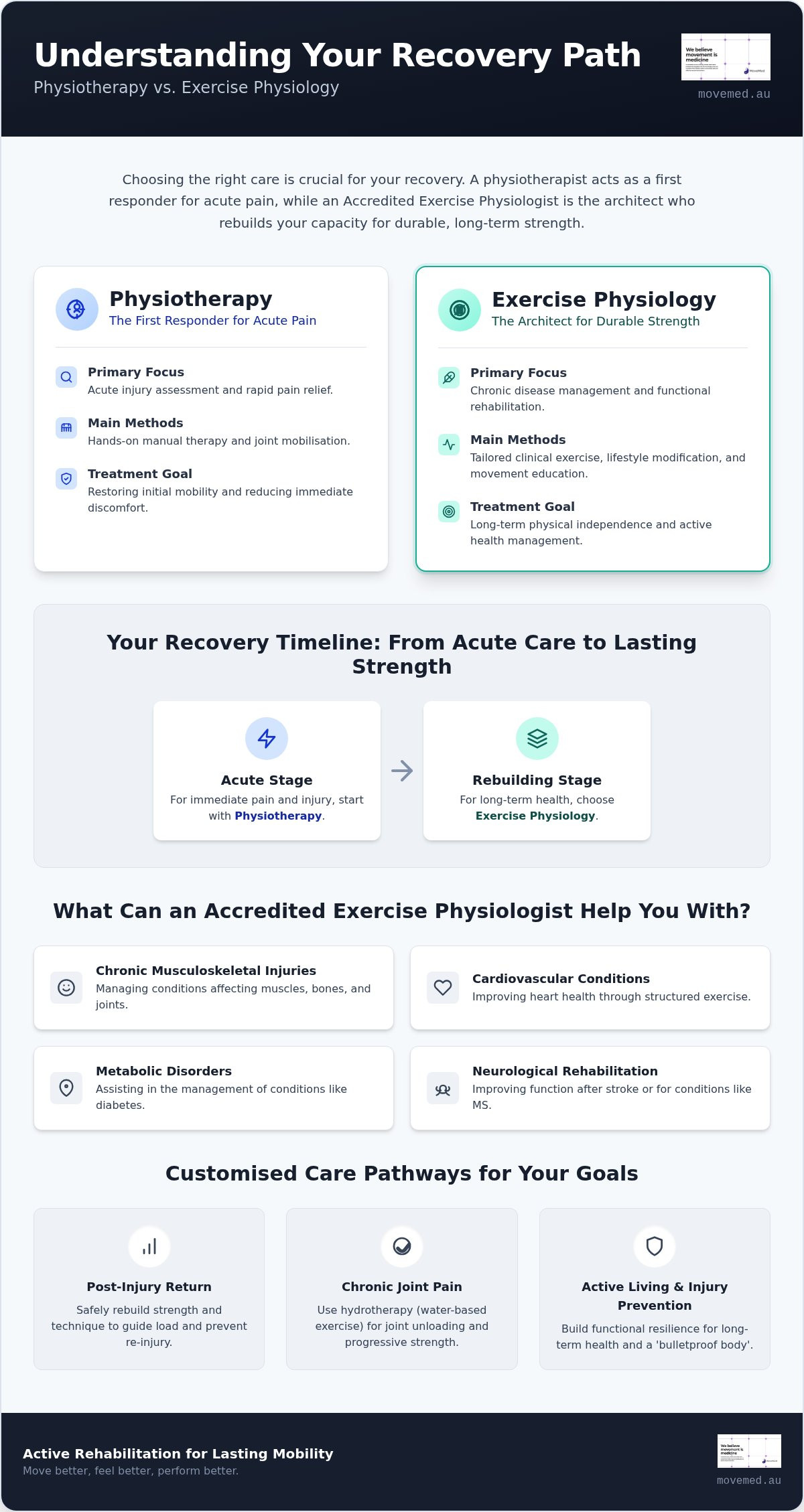
- Post-injury return to daily movement: work with an Accredited Exercise Physiologist (AEP) who guides load and technique so you rebuild safely rather than re-injure.
- Chronic joint pain such as arthritis: use water-based exercise (hydrotherapy) for joint unloading and progressive strength without high ground-impact stress.
- Active living and injury prevention: follow focused bulletproof body protocols that build functional resilience before the next setback.
If you are recovering from an injury, an AEP guides your movement safely. AEPs at MoveMed Templestowe craft research-backed management programs fitted to your physiology; true progress still demands consistent commitment rather than immediate fixes. You can meet the clinical team to see how structured care supports daily rehabilitation. More on this: Our Team.
Managing chronic pain like arthritis calls for targeted aquatic therapy. Hydrotherapy offers gentle support while you build strength: buoyancy unloads the joints so your muscles can work with less compressive stress, much like temporary training wheels while capacity returns.
Active individuals who want to reduce future injury risk need functional strength routines. Bulletproof body protocols build resilience for long-term health.
Book an assessment to start a targeted rehabilitation plan that matches your pathway.
Why exercise physiology differs from physiotherapy for lasting strength
Physiotherapy diagnoses and treats acute pain using hands-on manual techniques, whereas exercise physiology uses active movement to manage long-term conditions. Knowing which discipline leads at your stage of healing keeps care efficient and safer.
A physiotherapist acts as a first responder who settles the immediate problem. An AEP then acts as the architect who rebuilds capacity for durable strength. AEPs based at MoveMed Templestowe design scientifically validated care strategies specific to your body. Active clinical exercise still requires your ongoing participation and cannot offer a passive quick fix.
| Care Aspect | Physiotherapy | Exercise Physiology |
|---|---|---|
| Primary Focus | Acute injury assessment and rapid pain relief | Chronic disease management and functional rehabilitation |
| Main Methods | Hands-on manual therapy and joint mobilisation | Tailored clinical exercise, lifestyle modification, and movement education |
| Treatment Goal | Restoring initial mobility and reducing immediate discomfort | Long-term physical independence, active health management, and building a bulletproof body (injury prevention) |
Physiotherapy suits early-stage injury recovery, while long-term health management needs structured active care. You can combine active movement with hydrotherapy services (water-based exercise) to work toward long-term goals safely. Focus on active rehabilitation to move better, feel better, perform better.
Conditions clinical exercise physiology is built to treat
Accredited Exercise Physiologists treat chronic musculoskeletal injuries, cardiovascular conditions, metabolic disorders, and neurological rehabilitation needs. If your goal is lasting function rather than a short burst of symptom relief, clinical exercise is often the right tool.
AEPs operating out of MoveMed Templestowe shape individual management routines for your biology. Targeted clinical routines cannot reverse structural tissue damage instantly, so the work centres on long-term functional adaptation. Structured movement supports long-term health because guided resistance training builds joint resilience better than passive rest alone.
Enhancements in your metabolic profile typically show up long before the bathroom scale reflects progress. Tailored movement restores vital strength when you stay consistent.
Movement acts as medicine. Water-based exercise supports low-impact joint unloading, and targeted strength training supports injury prevention (bulletproof body). Active rehabilitation suits people seeking lasting mobility; short-term passive therapies mainly serve temporary symptom relief. Meet the Templestowe team to begin a personalised plan.
When you should pause before starting clinical exercise
Acute trauma requires immediate medical assessment or hands-on physiotherapy before structured movement programs begin. Starting too early is one of the common reasons rehab stalls.
In clinical practice, prescribing active rehab too early during a severe flare-up can cause unnecessary distress. Immediate surgical consultation or manual therapy takes priority when structural damage is fresh. An AEP focuses on progressive movement, not emergency diagnosis.
Acute care settles the crisis; exercise physiology rebuilds the structure once that phase has passed. Active rehab fits long-term recovery best, while acute therapies serve immediate crisis management.
Physical rehabilitation must match your specific stage of healing. If you are navigating chronic conditions or long-term disability, working with your NDIS exercise physiologist pathway provides an ongoing framework. At MoveMed, AEPs deliver evidence-based management plans tailored to your biology and state the limits of the approach openly. You need medical clearance first when the presentation is acute.
How NDIS, DVA and other schemes fund your sessions
Third-party schemes like NDIS, TAC, WorkCover, Medicare, and DVA cover your exercise physiology sessions fully or partially depending on your claim details. Sorting paperwork before session one usually saves you time and out-of-pocket stress.
Funding pathways run more smoothly when your GP referral and claim details are aligned before the first appointment. Clear administrative setup keeps your energy on recovery goals.
At MoveMed Templestowe, AEPs deliver evidence-based management plans tailored to your biology. Third-party funding still requires specific medical referrals and scheme approvals before coverage applies. Processing claims needs structured documentation. You can access individual billing or scheme funding depending on your coverage type.
| Funding Pathway | Ideal For | Requirements |
|---|---|---|
| NDIS | Disability support | Plan-managed or self-managed goals |
| TAC & WorkCover | Accident recovery | Approved claim number |
| Medicare (CDM) | Chronic conditions | GP referral plan |
| DVA | Veterans | D904 GP referral |
Long-term progress relies on consistent clinical care. Seeing how other families manage their care helps set expectations.
Among MoveMed's Google reviews, Martin (5★) wrote:
"My son and I have been seeing Arthur and his team of Exercise Physiologists for years. We have been very impressed with their level of professionalism and skill. A special shout out to both Gilbert and Arthur."
Long-term clinical support under structured exercise programs helps families achieve consistent health outcomes.
Four steps to book your consultation and start strong
Booking an initial assessment with an Accredited Exercise Physiologist is a structured process aimed at your movement goals. Port Melbourne residents often attend MoveMed Templestowe for that first clinical session.
- Submit your online booking: Select your preferred clinical session time using the digital portal.
- Complete the intake paperwork: Provide your medical history and specific movement goals before your appointment.
- Attend your consultation: Participate in a movement assessment designed for injury prevention.
- Receive your custom plan: Get a tailored, evidence-based exercise strategy built for your daily routines.
Bringing past medical imaging or scan reports to your first session helps streamline the functional assessment. That first step gives you targeted guidance grounded in clinical research and maps milestones clearly so you can move better, feel better, perform better.
What local consultation fees and session costs depend on
Consultation fees for clinical care across the local market depend on session duration, initial assessment depth, and practitioner qualifications. Knowing those drivers before you book makes budgeting simpler.
Funding pathways like Medicare, private health insurance, NDIS, or DVA directly lower out-of-pocket expenses. That relief makes long-term rehabilitation more manageable. Choosing a thorough initial assessment helps shape an effective bulletproof body plan. At MoveMed, each AEP provides tailored, evidence-based care.
Ask for a personalised quote so your plan and budget line up from day one.
Frequently asked questions
What does an exercise physiologist do?
An Accredited Exercise Physiologist prescribes tailored movement plans to help you recover from injury and manage health conditions. Exercise physiology is not a miracle cure, so your movement strategy requires active commitment alongside professional guidance.
Can exercise physiology help with chronic diseases?
Yes, evidence-based targeted exercise directly improves your physical function and helps manage long-term health conditions safely. Targeted movement lowers clinical risks while building lasting strength so you can move better over time.
Can I book an appointment online?
You can schedule your initial assessment through the online portal at any time. Online booking takes minutes, and the team will welcome you at your chosen session.
What services are offered?
Clinical exercise programs, injury prevention strategies, and water-based exercise are tailored to your personal goals, with safety built into each plan.
Where is the clinic located?
The clinic operates in Templestowe, Victoria, and provides dedicated clinical care to the local community, including people seeking an exercise physiologist from Port Melbourne. Visit the facility when you are ready to begin.
Take the Next Step with MoveMed
Working with an Accredited Exercise Physiologist helps you rebuild strength safely. MoveMed provides accredited exercise physiology and structured rehabilitation services tailored to your health goals in 2026. Personalised management plans must account for your biology rather than generic workout myths.
You do not have to manage recovery alone. The team guides you through evidence-based plans designed to improve mobility and reduce pain. Ready to start? Book your appointment online today to meet with an exercise physiologist Port Melbourne residents use for targeted care. More on this: Contact & Book.


